I’m excited today about going out on my first game drive for nearly 4 weeks. The moon is full when we leave camp giving the morning a soft glow before the sun rises. As we head towards the main road, we see many vehicles stopped on the road, with many more racing to the same spot leaving huge dust trails behind them. It hasn’t rained now for a few weeks, so the land is very dry and the long grass no longer green but a pale yellow colour.
Ken managed to get a shot of this single Topi standing in the middle of the dust filled air stirred up by the passing vehicles. This is high season in the Mara with hundreds of people from all over the world expected, in the hope of witnessing the annual migration of wildebeest and of course the ‘Big Cats’. Which is what we have here.
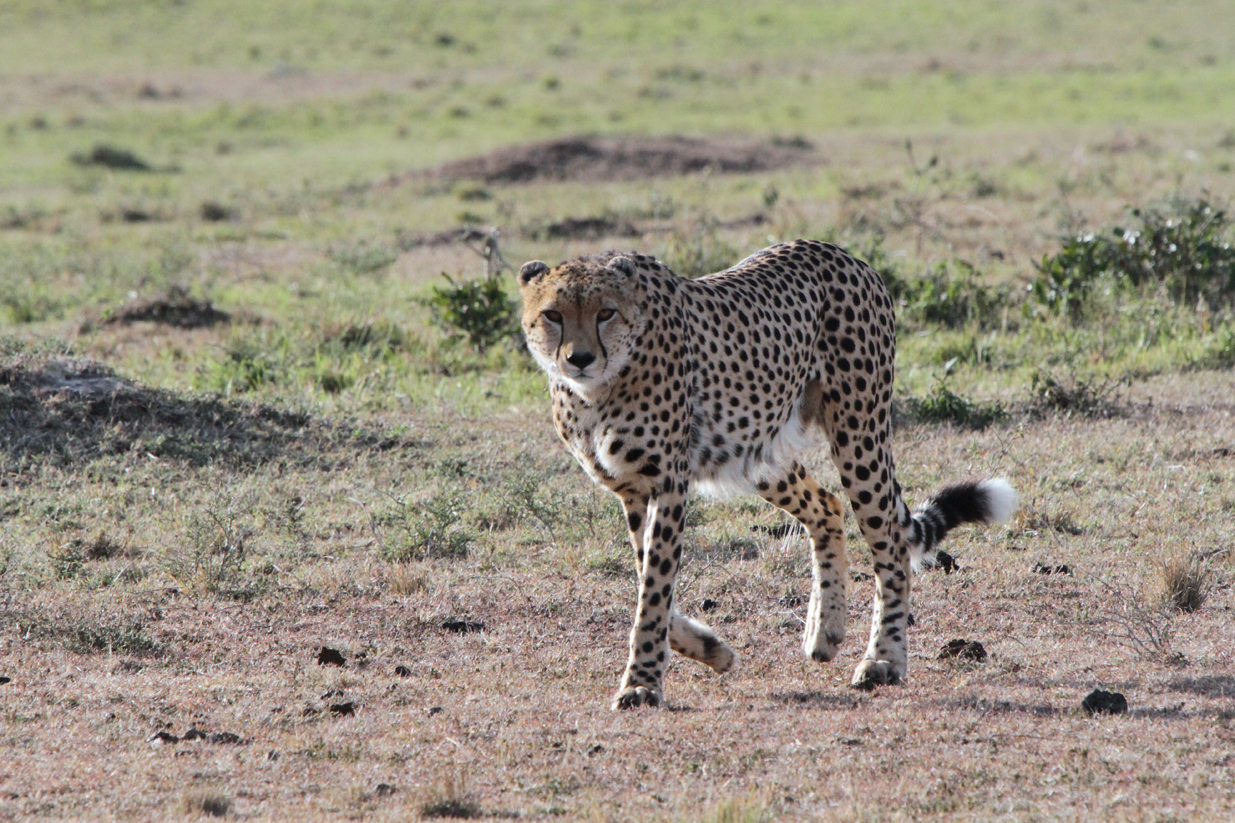
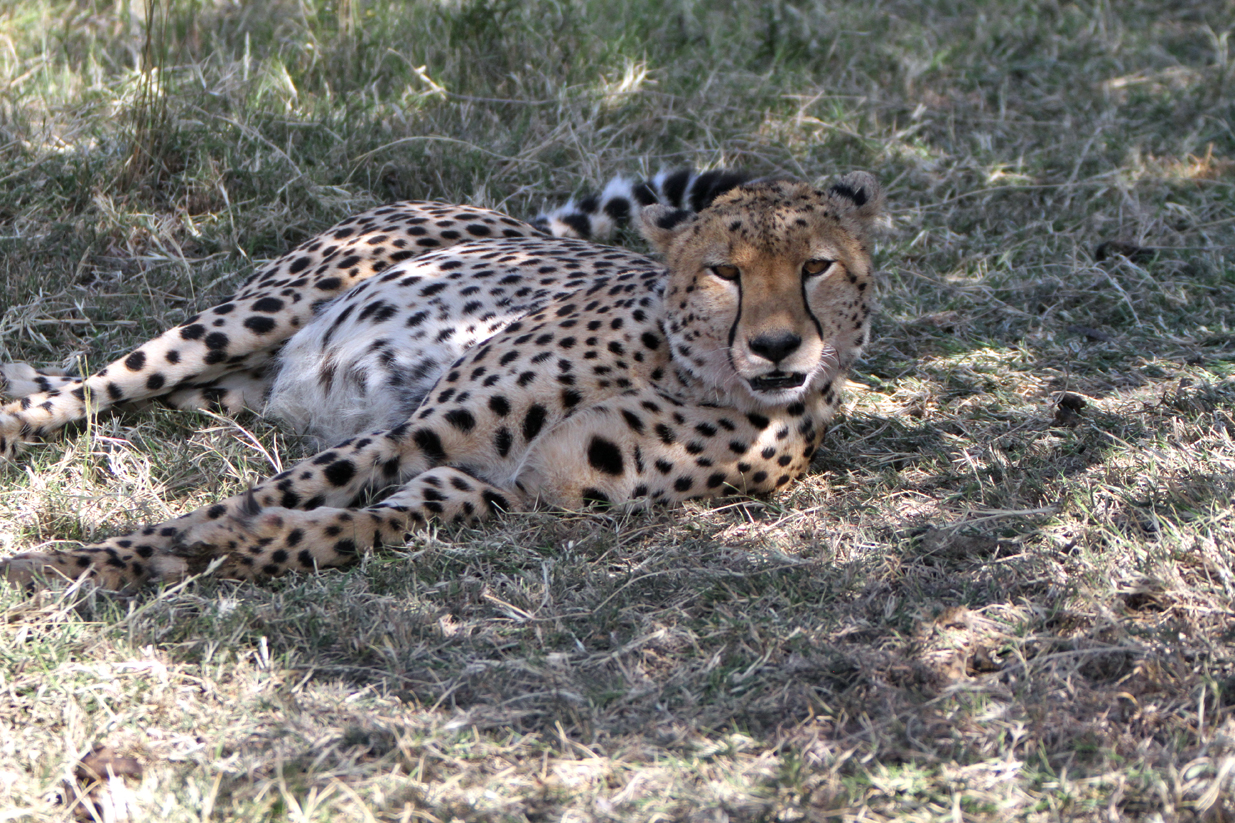
Our male cheetah Olodupa is sitting by the main road making it easy for the visitors to get up close to him. How he remains so relaxed when surrounded by about 30 vehicles is a mystery to me, but he does it. He is also surrounded by wildebeest and Zebra. A couple of times he gets up, looks for a possible target, picking out a baby from the herd, we think he might hunt, but he is not too serious. He trots one way and then another barely breaking into a run let alone a full-on sprint.
The wildebeest, keep pace with him, run a little when he chases them, then stop and face him when he stops, always keeping him in their sights although no going very far. It’s like a dance, they are both involved in, a dance of death maybe for one of them. Zebra look on from the sidelines, they know they are not in any danger as a zebra is too strong for a single cheetah. Since Olodupa is not in a hunting mood right now we move off, heading towards the Sand River and Mara River to see if any of the wildebeest are ready to cross.
Driving through the long grass my attention is caught by something dark and straight sticking up out of the undulating grass. It was the head and long neck of a heron. Herons are fond of the long grass as it contains many insects that the heron like to eat. But it seems he doesn’t much care for our company, and he flies away.
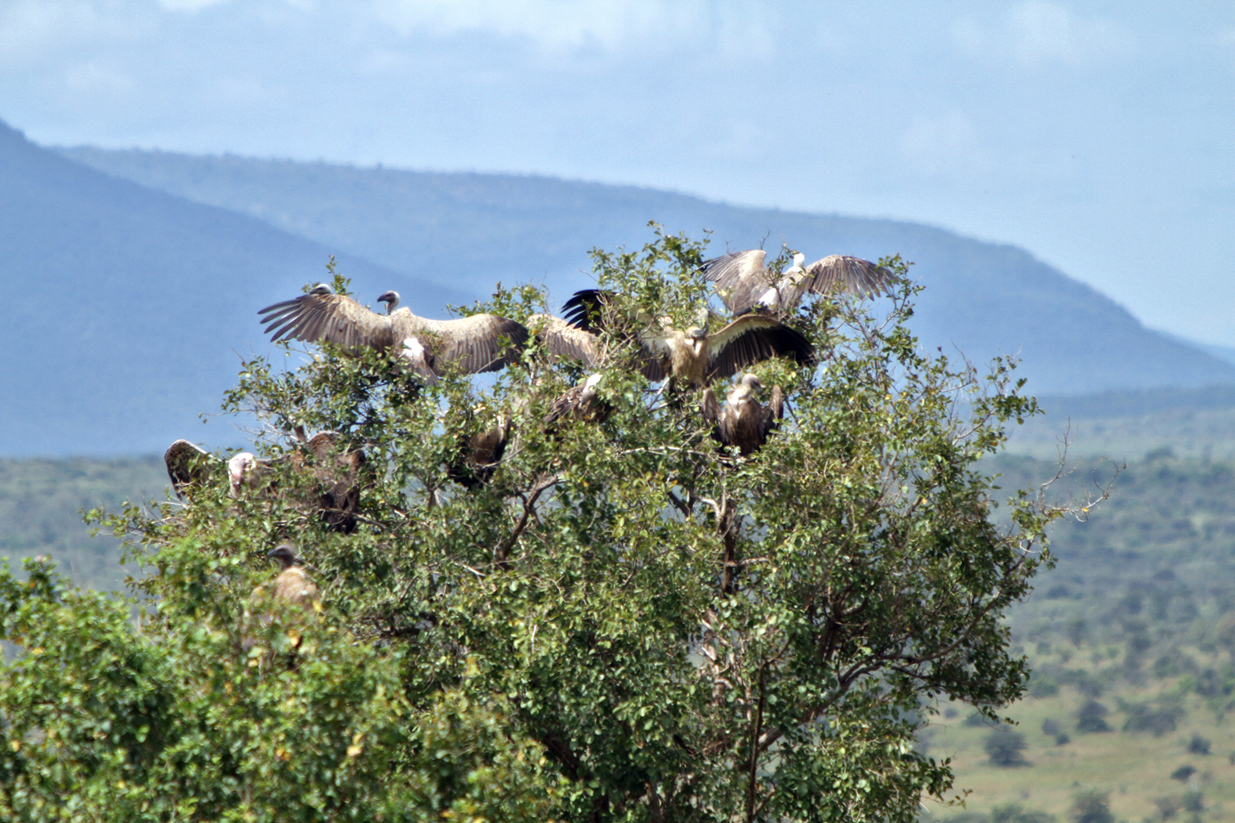
Alison notices that there are a few vultures circling off to our left, so we drive over to see what has caught their attention. It is the remains of a fresh and very smelly carcass, that of a small wildebeest and Alison believes it was a leopard kill because none of the rib bones are broken. Not long after this we see another gathering of vehicles in the distance, it can only mean one thing, it’s one of the cats. We don’t have to go searching for the cats during high season, within minutes of a cat being spotted it is surrounded by many cars. Personally, I prefer to go looking for them. There is so much more satisfaction of finally coming upon a leopard after a long search and being the only vehicle there.
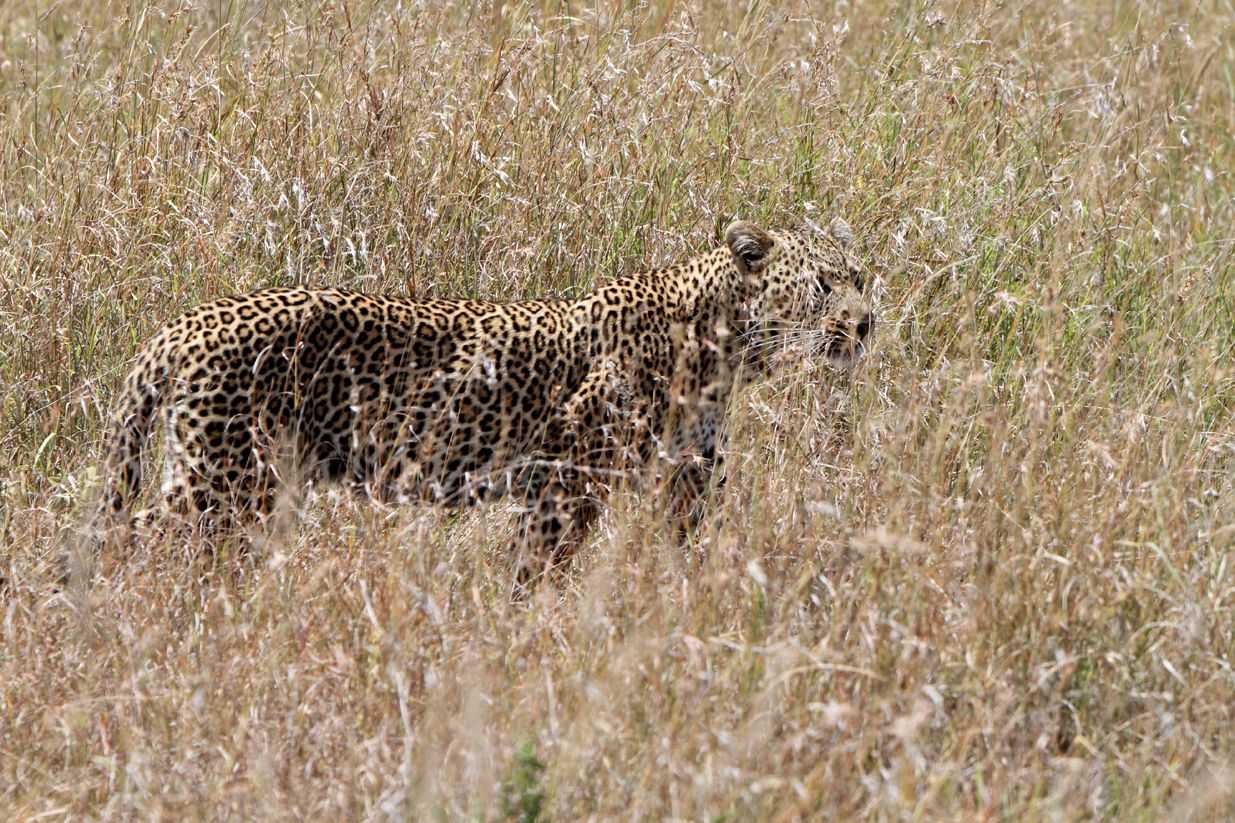
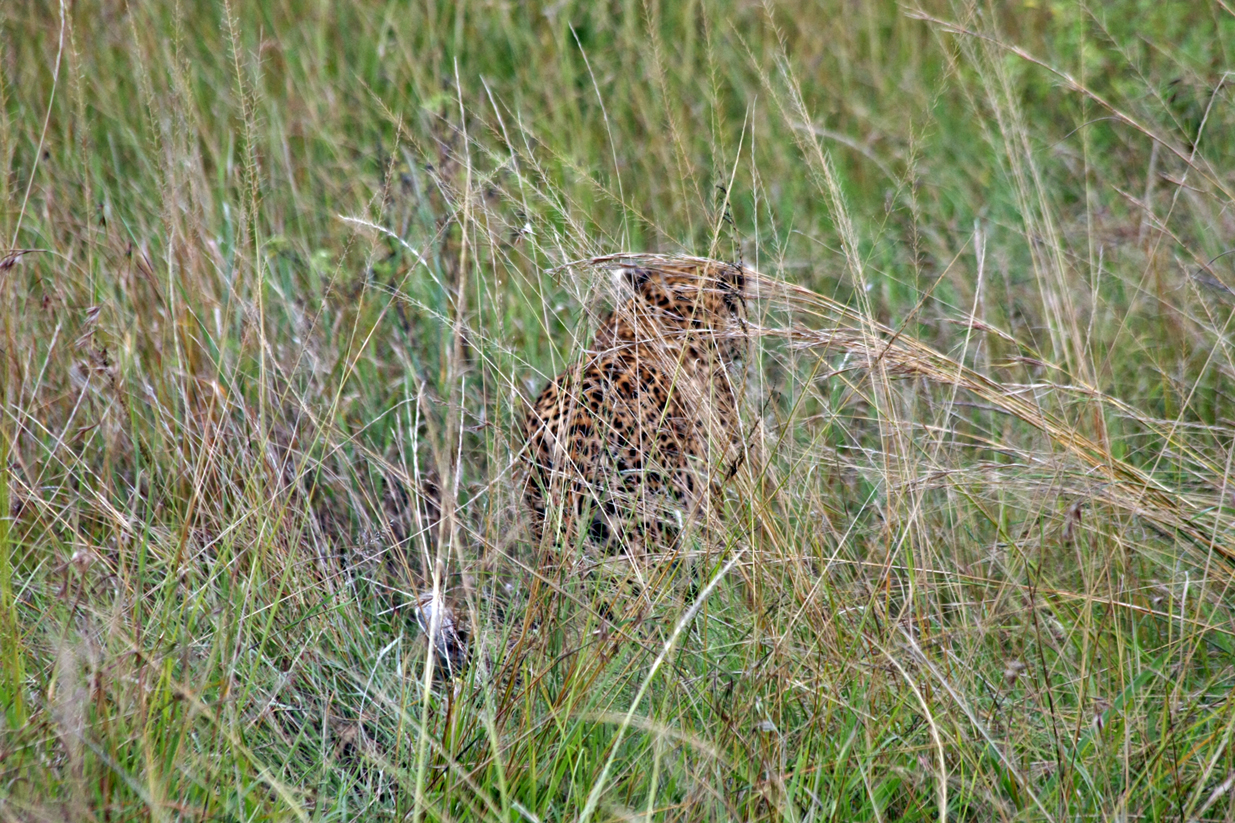
So, we head over to find the leopard concealed in a bush, it’s very difficult to see her and when she walks out it is still difficult to see her because she is camouflaged in the long yellow grass. She walks just a little way then settles back down again under another bush; however we do get a good look at her here and Alison is sure it’s Kazuri. We have seen Kazuri quite a few times, once with her daughter Nantito. I know leopards can be recognized by looking closely at certain patterns on their head and neck but for me it is not easy to tell them apart.
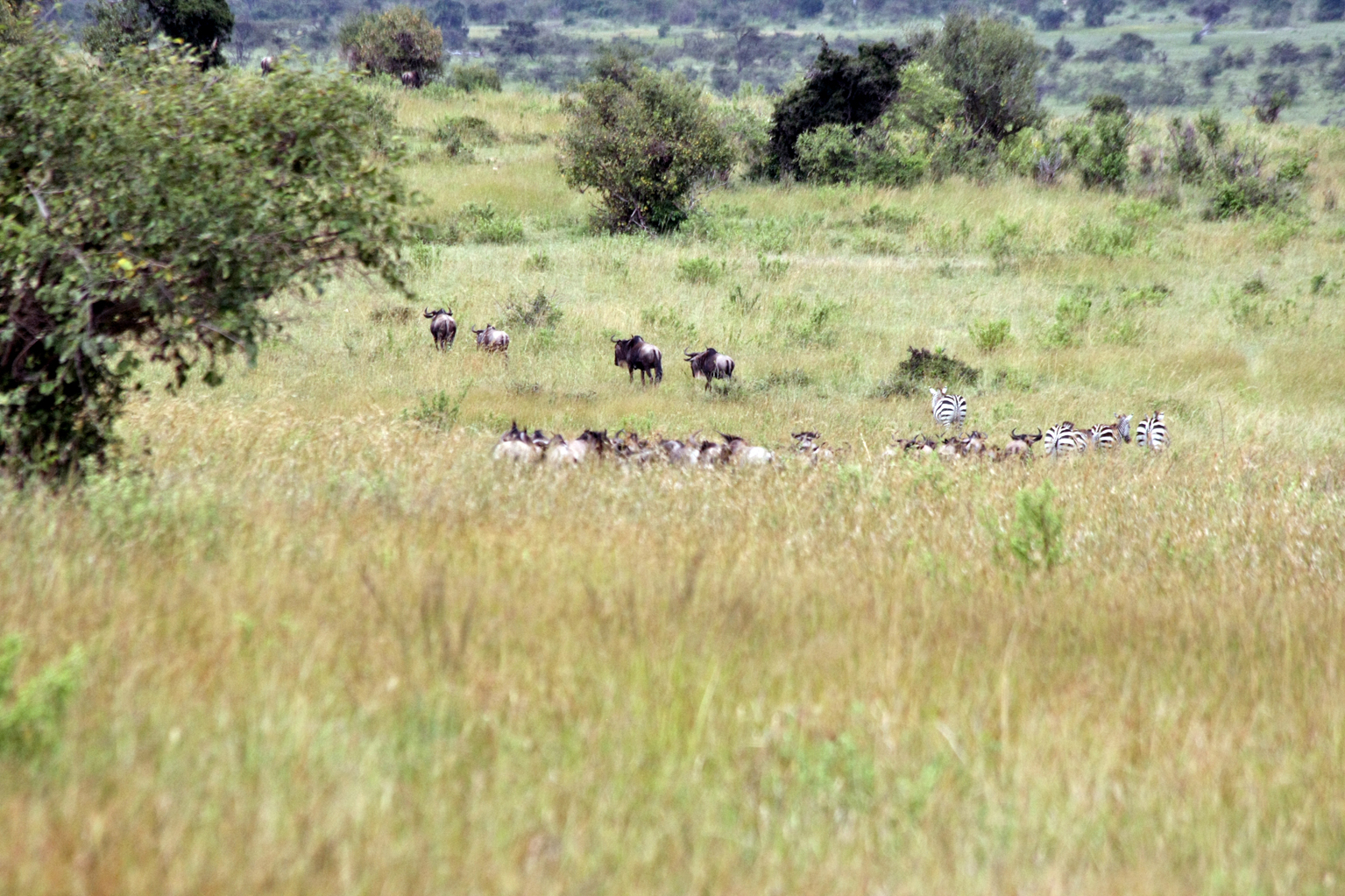
The closer we get to the Tanzanian border the larger the groups of Wildebeest and Zebra, in some cases there are herds of more than 300 wildebeest, but this is still only a fraction of what is slowly making its way towards the Mara, despite efforts to keep them in the Serengeti. We see the thick smoke, from the fires they light to dissuade the wildebeest from coming, it may slow them but ultimately it doesn’t work. We try the Sand River first, this river feeds into the Mara River and many wildebeest take this route. They are gathering on the other side but show no signs yet of wanting to cross so we try the Mara River. There are already large numbers of wildebeest on this side of the river, those that have already crossed and survived the crocodiles that lie in wait for them, but none on the other side. Since there is no ‘action’ we have lunch and head back to camp. Although we didn’t’ see any wildebeest crossing today I am hopeful that we will see them cross at some time, maybe on our next game drive. The photo at the top is from last year’s migration.
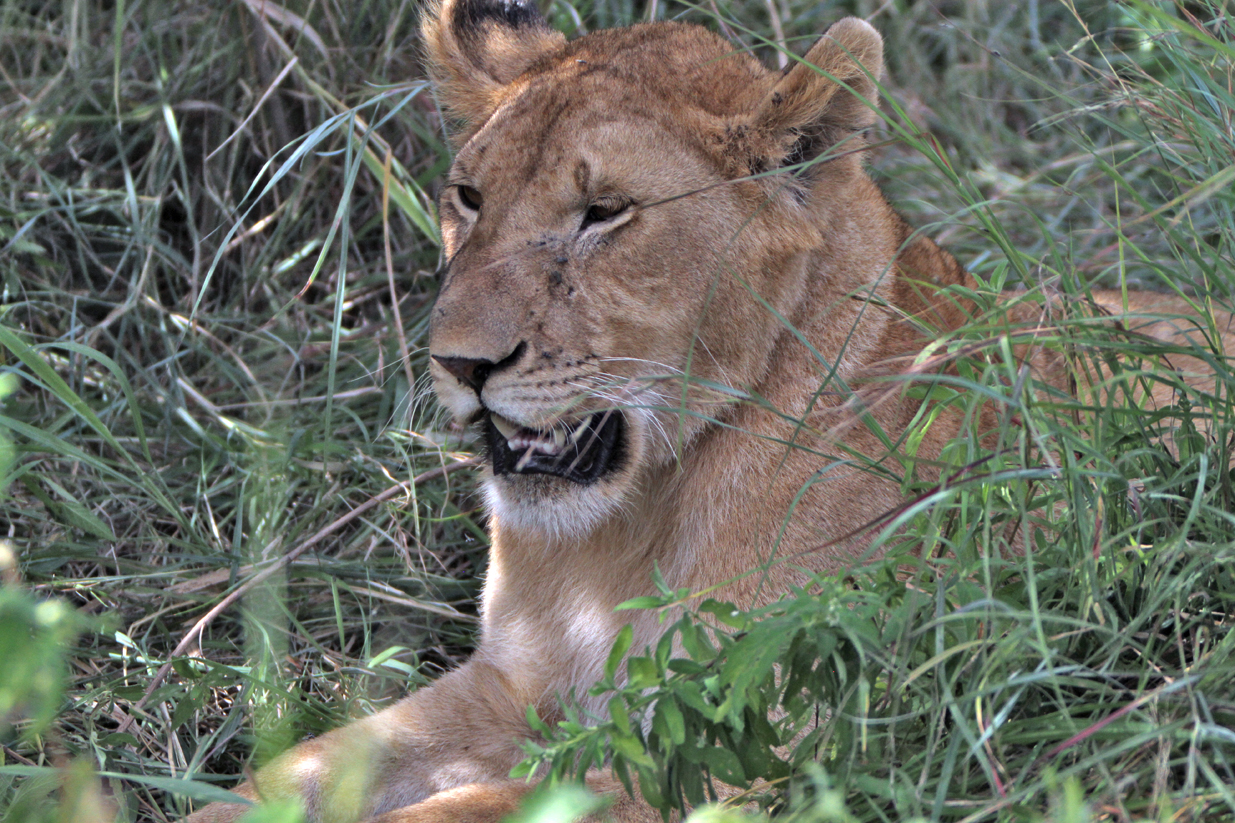
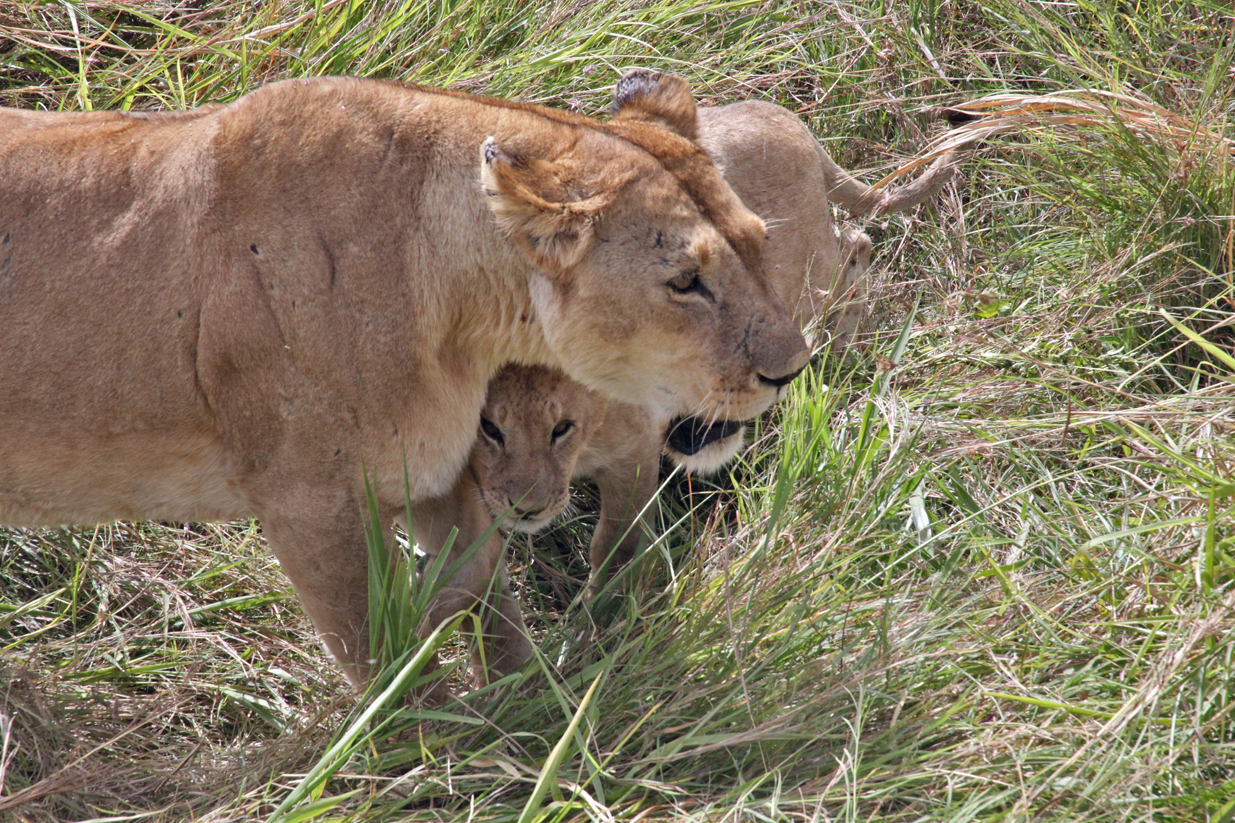
On the way back we see yet again a large group of cars, this time they are looking at lions. It is a couple of females, two young cubs and a slightly older cub. Alison thinks this is two of the BlackRock females and their cubs if this is so the cubs have certainly grown. It has been quite a while since we last saw them, maybe even a couple of months, they have been hiding, so I was particularly excited to see them again. They had also been feasting on wildebeest, maybe these two females have brought their cubs to this place to be closer to the food.
Now that the migration has begun, and the supply of wildebeest is plentiful they are the easiest of prey.
As we near home, driving along the main road we are stopped in our tracks by a black Mamba. It is in the middle of the road right in front of us, it has reared up, flattening his head in the strike position and has no intention of giving way. We slowly drive around it and once we have passed, it slithers away. If there is one snake you don’t want to mess with it’s a black mamba, they are deadly poisonous.
Then we finish our game drive as we started with Olodupa. We find him not far from camp in the shade of a tree, with a full stomach, feasting on a baby wildebeest. So, he took his time and finally caught one. This time there is not so many vehicles watching his every move so he can eat in peace. I think he will eat well over the next couple of months until the wildebeest return to the Serengeti. It is time to say goodbye to him and return to camp, although I am sure we will be seeing a lot of him in the near future
This week since I have broken my wrist and am unable to get out into the park for at least another couple of weeks a good friend and travel agent, Thyra Rutter has written a blog this week about her experience on a game drive during her stay with us at Fisi Camp. So, enjoy and I will be back just as soon as my wrist heals.
A silent cheetah stalks its prey. Waiting for what seems like ages to make a move. Watching, waiting until, at a precise moment the cat launches into a full speed chase! Using perfectly choreographed actions, the lead cheetah drives its unfortunate prey (a topi) from the safety of its herd. Suddenly, two other cheetahs join the fray, erupting from the bush like four legged rockets. The three cats, joined together in complex maneuvers, attack. One cheetah leaping at the topi’s haunches, a second going for the exposed flanks with the largest of the three sinking its claws and teeth into the neck.
For the topi it’s a mercifully quick and dramatic end to life in the savannah, for the cheetahs a hard-earned feast giving them necessary energy to face another day and for our safari guests, it was the thrill of a lifetime.
There is no denying, a day spent in the Masai Mara is unlike anything else on earth. Endless skies oversee cycles of drama that have evolved for centuries
Predator, prey and somewhat surprisingly, partnerships all have a part to play in the natural rhythms of the bush. From humble oxpecker birds hitching free rides on cape buffalo in exchange for removing pesky (for the buffalo) and delicious (for the oxpecker) ticks off of their “taxi” to the unlikely alliance of wildebeest and zebra, the former with better hearing and the latter with sharper eyesight, the animal kingdom is held together by partnerships.
It doesn’t take a biologist to note that like wildlife, human lives are enriched beyond measure by trusted relationships.
AFE Adventures, is proud to partner with the incredible folks at Fisi Camp to ensure our guest experience a safari that exceeds their wildest dreams.
This morning I am joining a group of guests from Arte for Elephants tours. These agents bring groups to our camp, from America, four or five times a year and they are always good fun to be with.
We have an early start, stopping briefly as we enter the park, to look at a large number of Zebra and Wildebeest that are gathering on the plains adjacent to our camp.
These Wildebeest and Zebra are from Tanzania, the first of the annual migration. Although it looks impressive it is nothing compared to what will follow. Thousands are now gathering on the border of Tanzania ready to enter Kenya and cross the Mara River, with all its dangers. It may be a while yet though before they decide to move as it is still raining in Tanzania, so the food is plentiful for them.
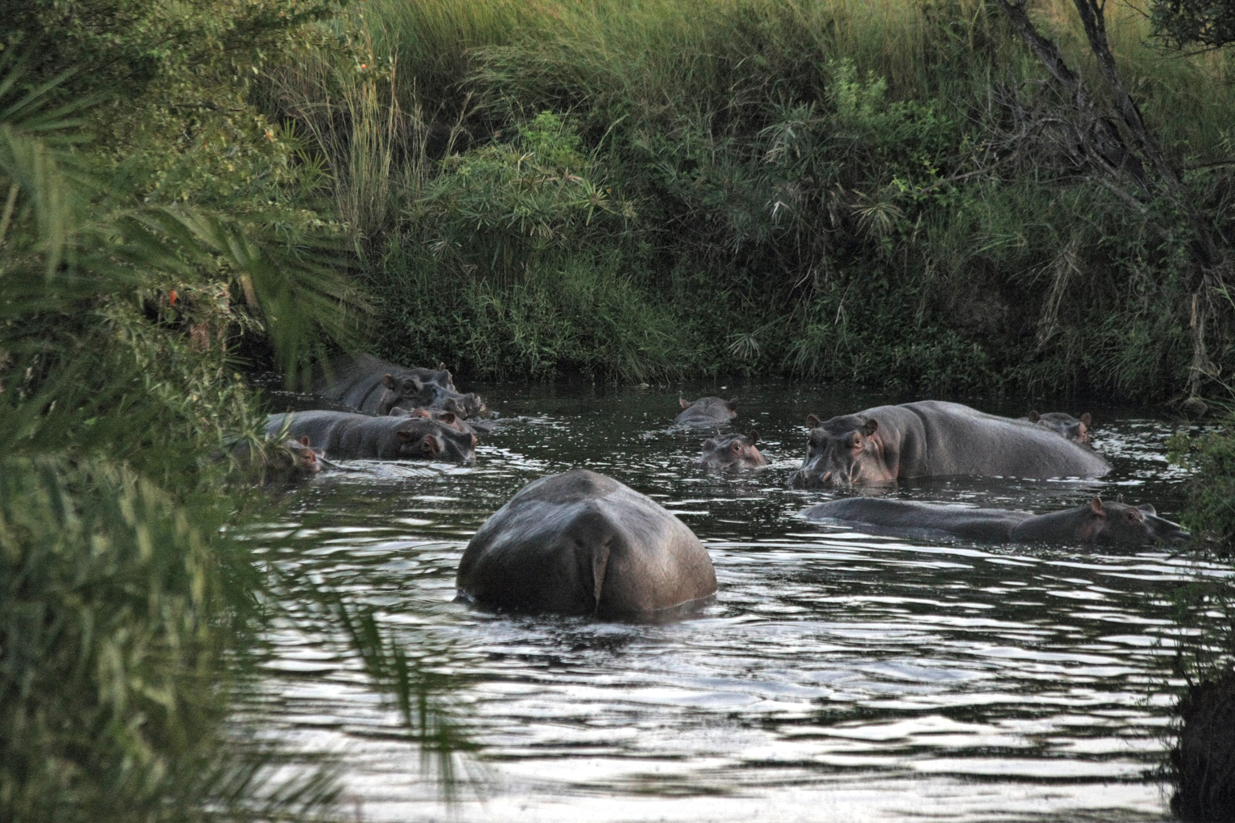
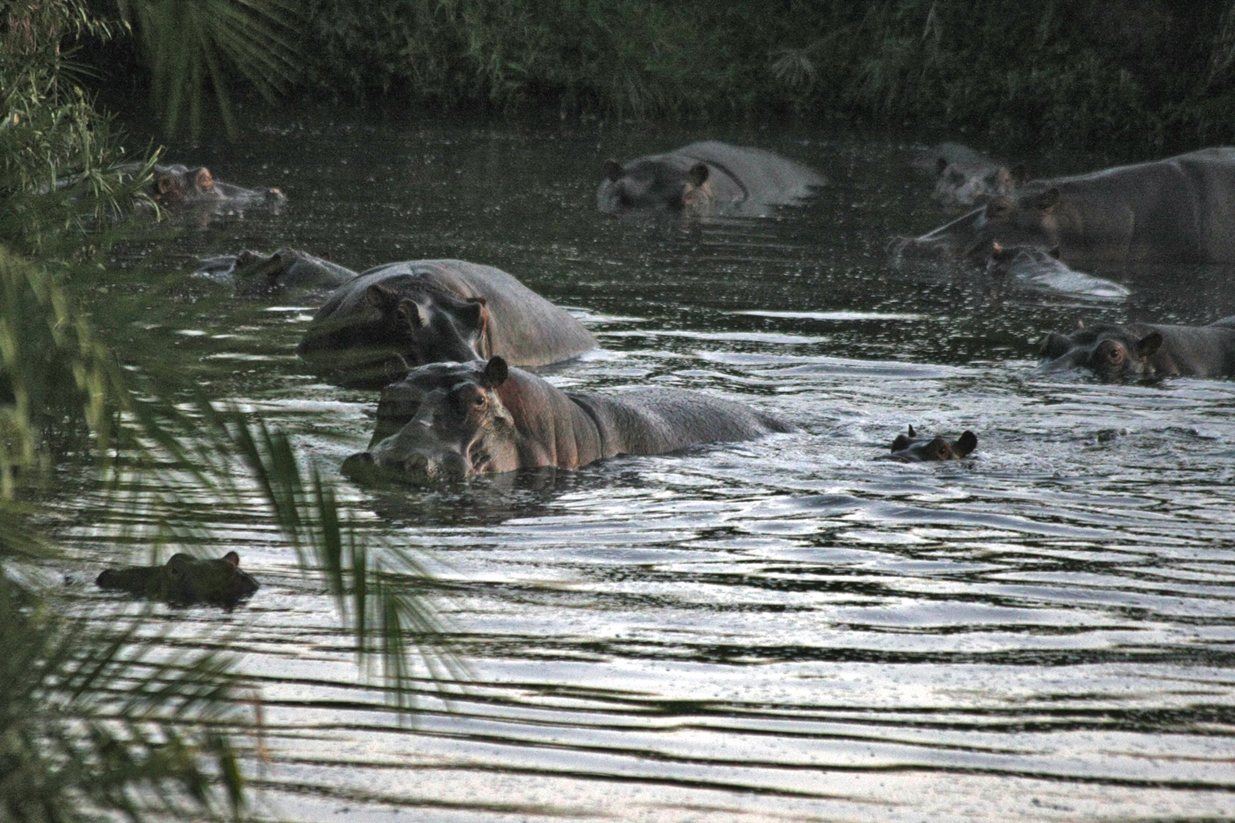
One member of our group really wanted to see Hippo’s and as luck would have it, we came upon a large male making his way towards the river, we followed and discovered a whole family of Hippo’s relaxing in the water, submerging then spraying water everywhere as they come up for air. The group consisted of adults, younger ones and we could see a baby, this was a very nice start to the game drive.
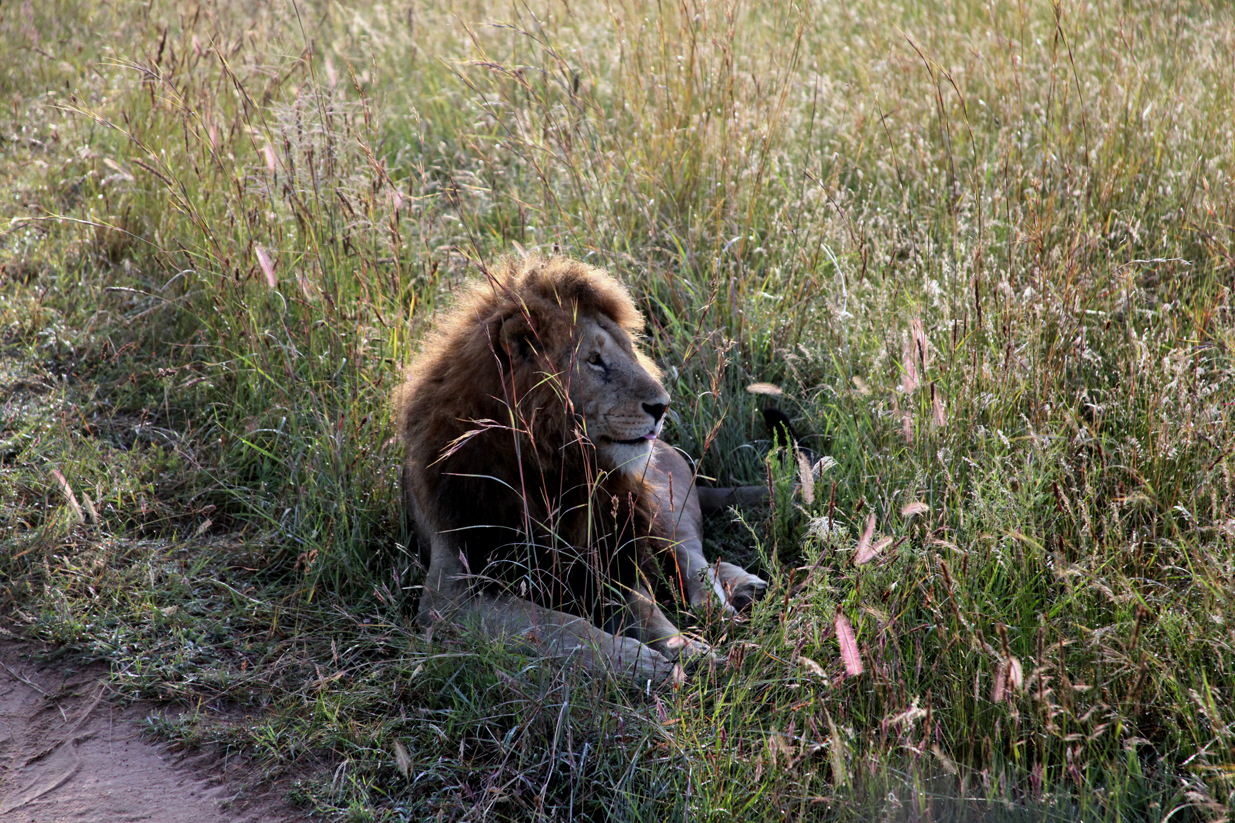
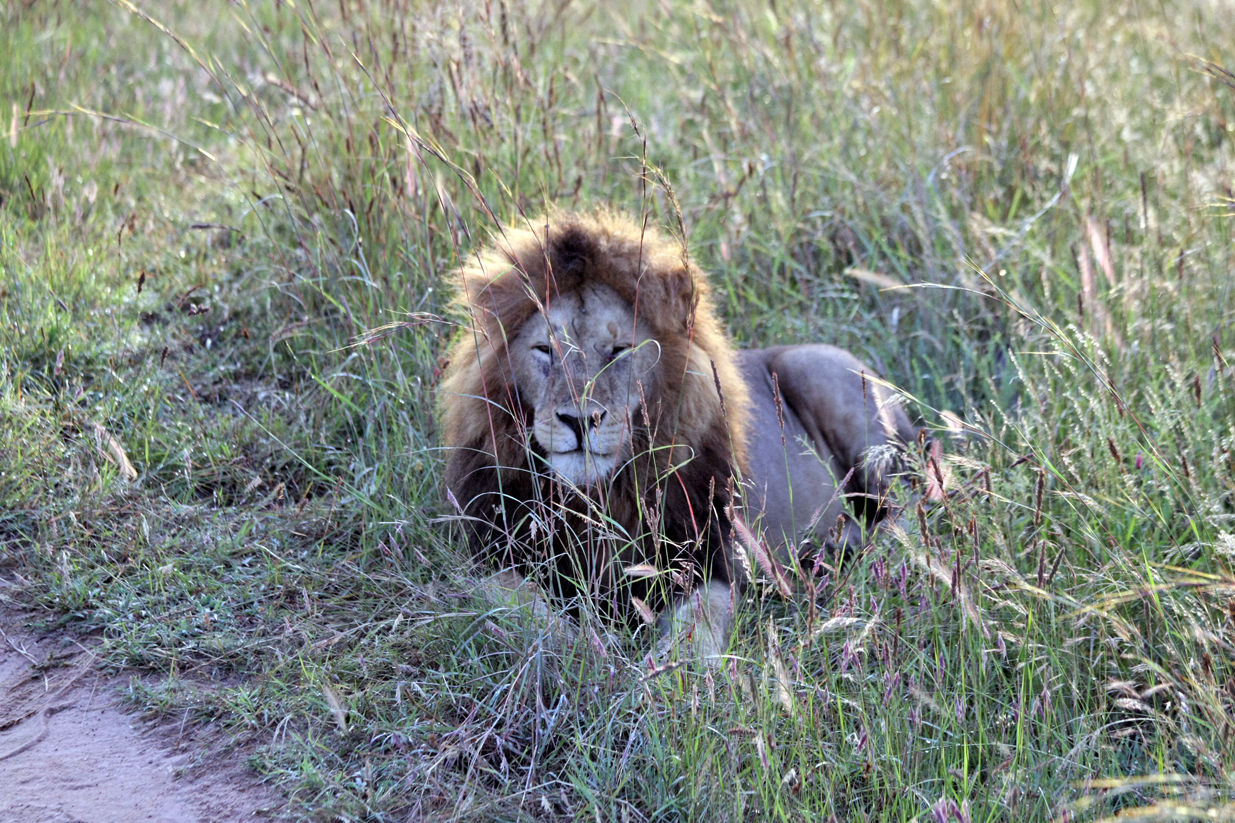
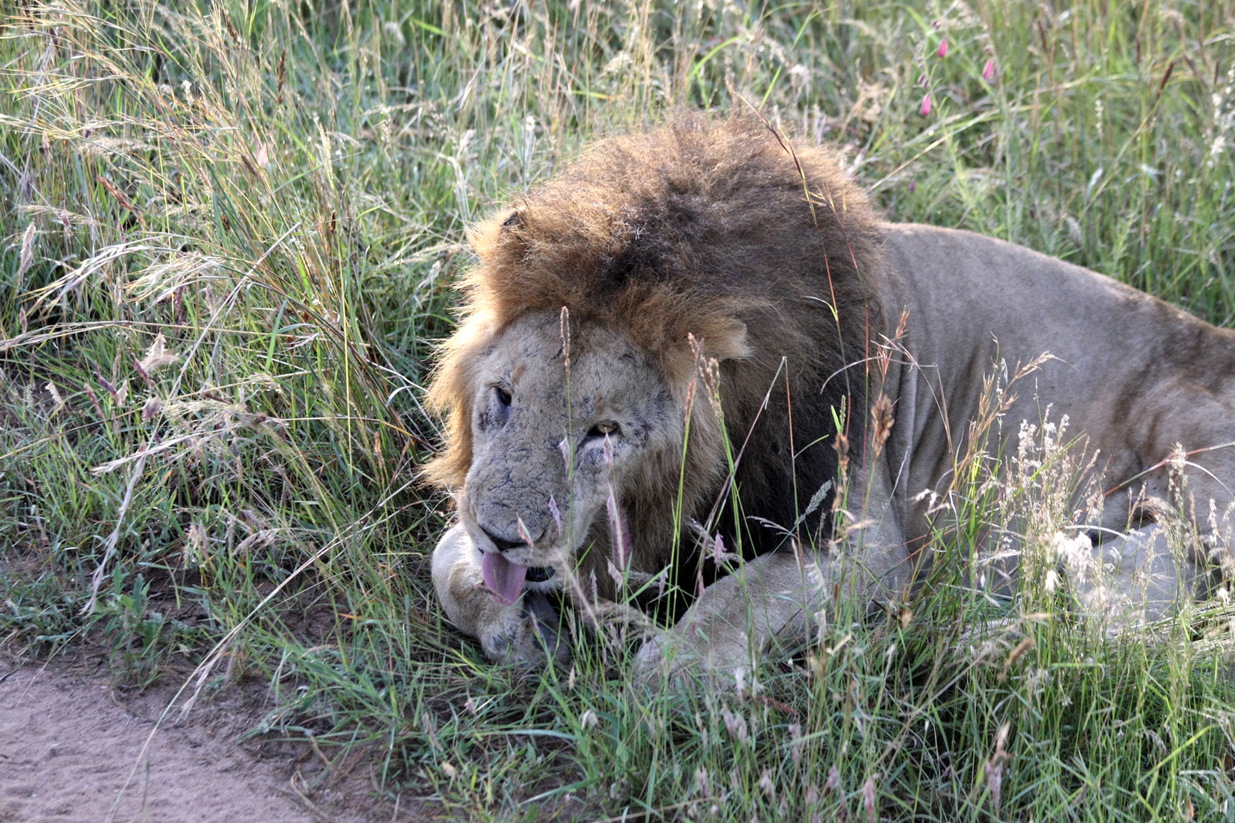
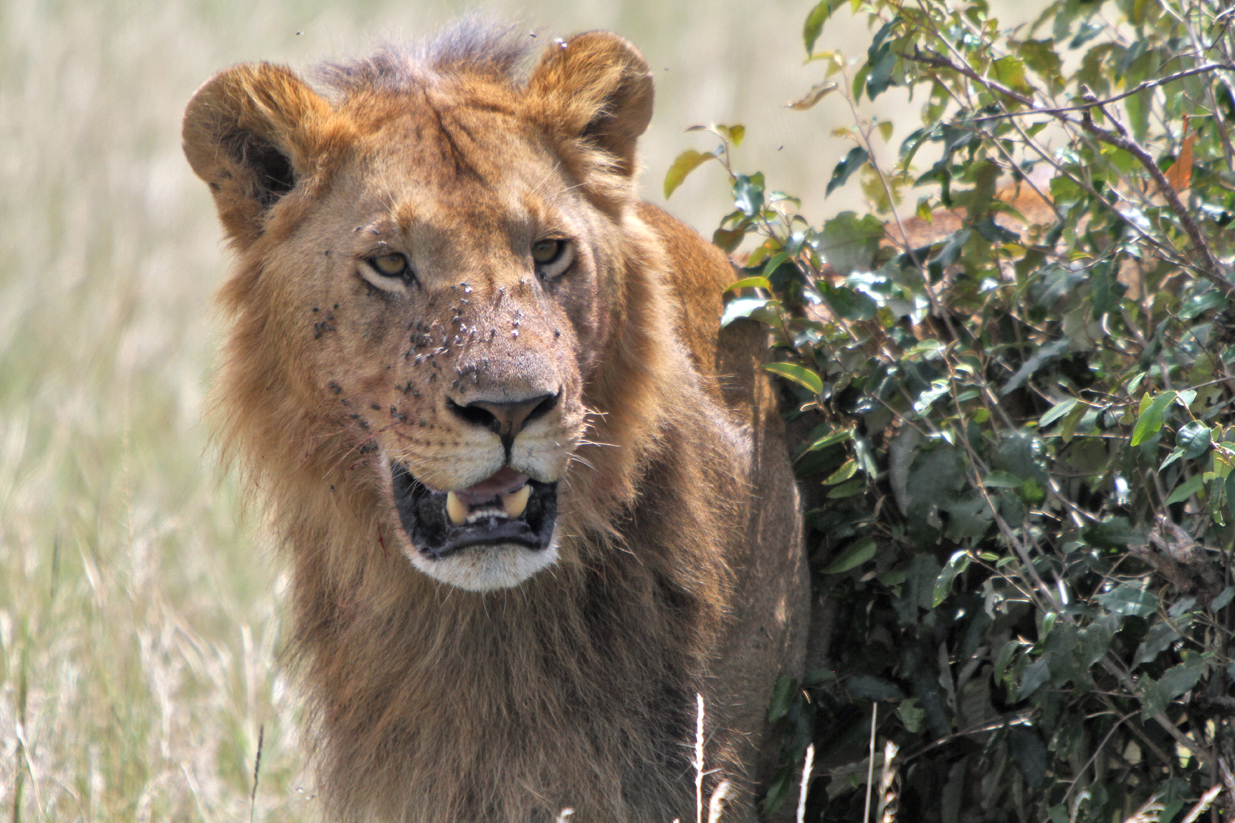
Shortly after this we left the main road and came upon two fully grown male lions, part of the sopa pride. The sun was only just above the horizon and the air was still and clear making it a cold morning. The lions were laying down cleaning themselves after their night activities, as we sat and watched my fingers were getting so cold where I held the camera, but the cold was forgotten as I focused to take the photos. The lions were not at all bothered by the cold as they basked in the early morning sun.
While we were watching the lions in silence a long low rumble was heard on the opposite side of the car, everyone turned towards the sound, it was elephants, but they were still quite far away, in this peaceful setting sound travels long distances. After around 15 minutes other vehicles started to arrive, while they lions seemed happy enough to ignore our two vehicles, they were bothered by the others turning up so they got up and moved further into the bushes where they could remain undisturbed. Our guests were very happy to have had that time alone with this magnificent pair.
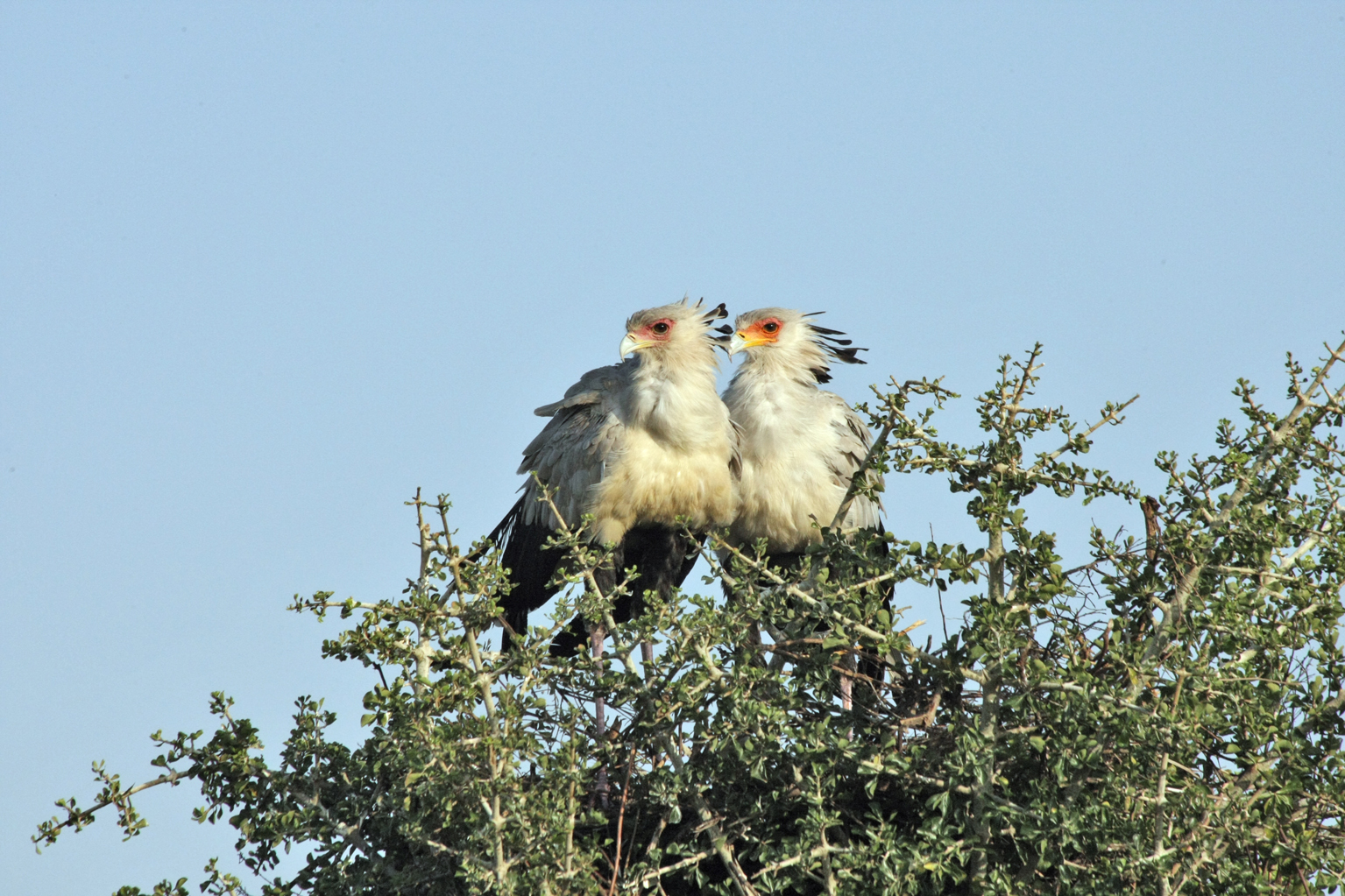
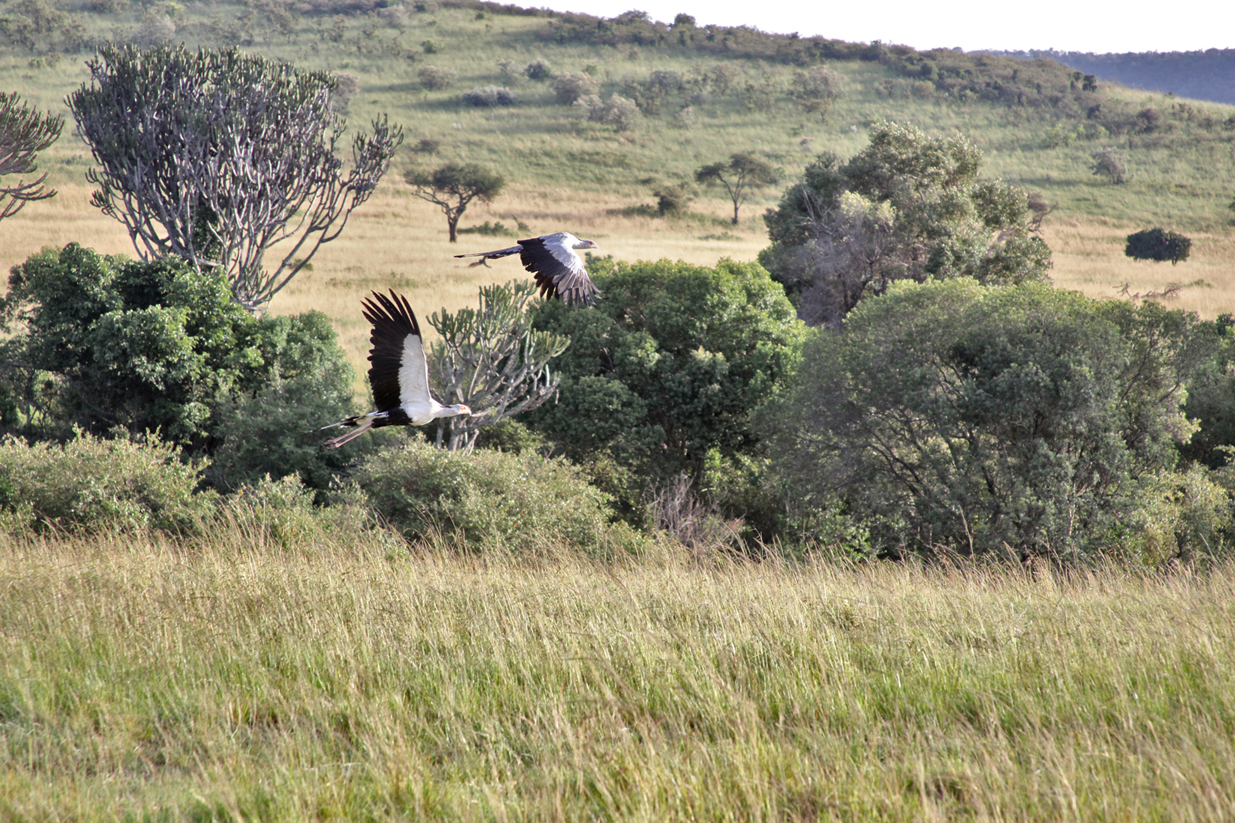
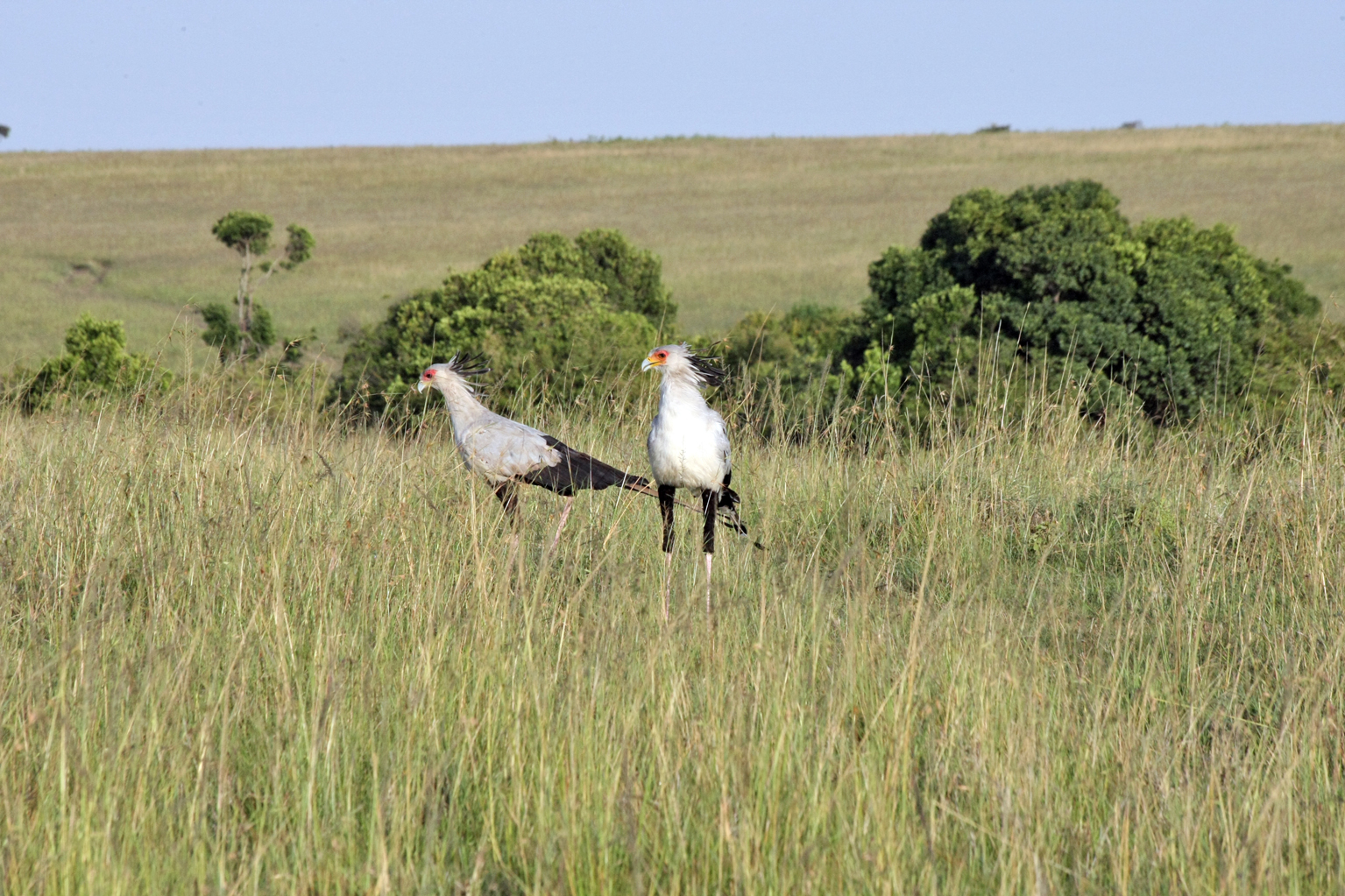
The sun was now well above the horizon in a bright blue sky, and it was starting to warm up a little when we came across two secretary birds in a tree. These birds are so elegant, whether on the ground where they are normally found, or perched in a tree. These two clearly looked as though they were a pair, sitting close together and even moving in sync. Suddenly they both took off at the same time landing in the long grass not far away. We drove over to them to find them strutting around looking on the ground for something to eat as they go. One of the birds was also collecting small twigs, perhaps for the nest.
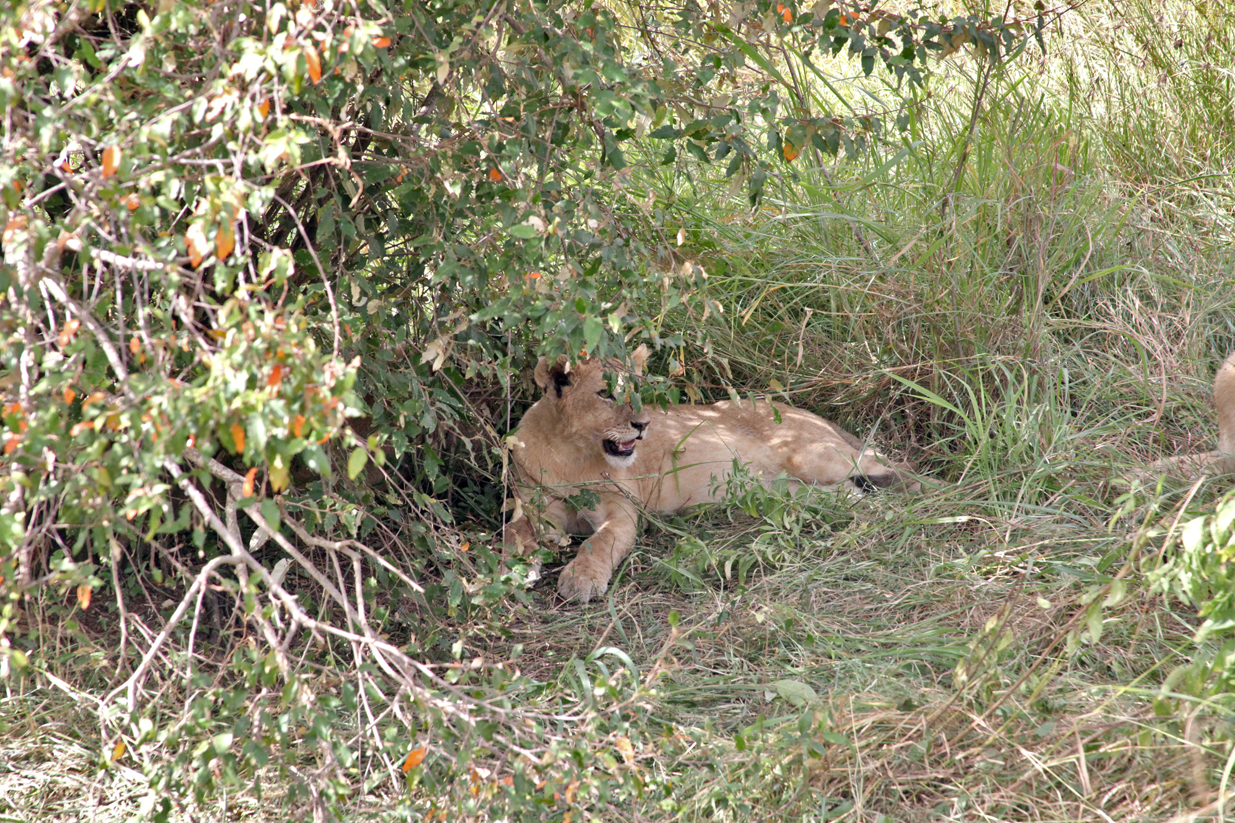
As we drove towards our breakfast spot there were a few vehicles stopped on the track, I didn’t immediately see what they were looking at, then I noticed a lioness with a cub barely visible, as you can see from the photo, in an area inaccessible to vehicles. There were more lionesses scattered around, but we couldn’t see them, a twitch of the grass here and there gave their positions away, they were very well concealed, which was nice for them but a little disappointing for all the visitors.
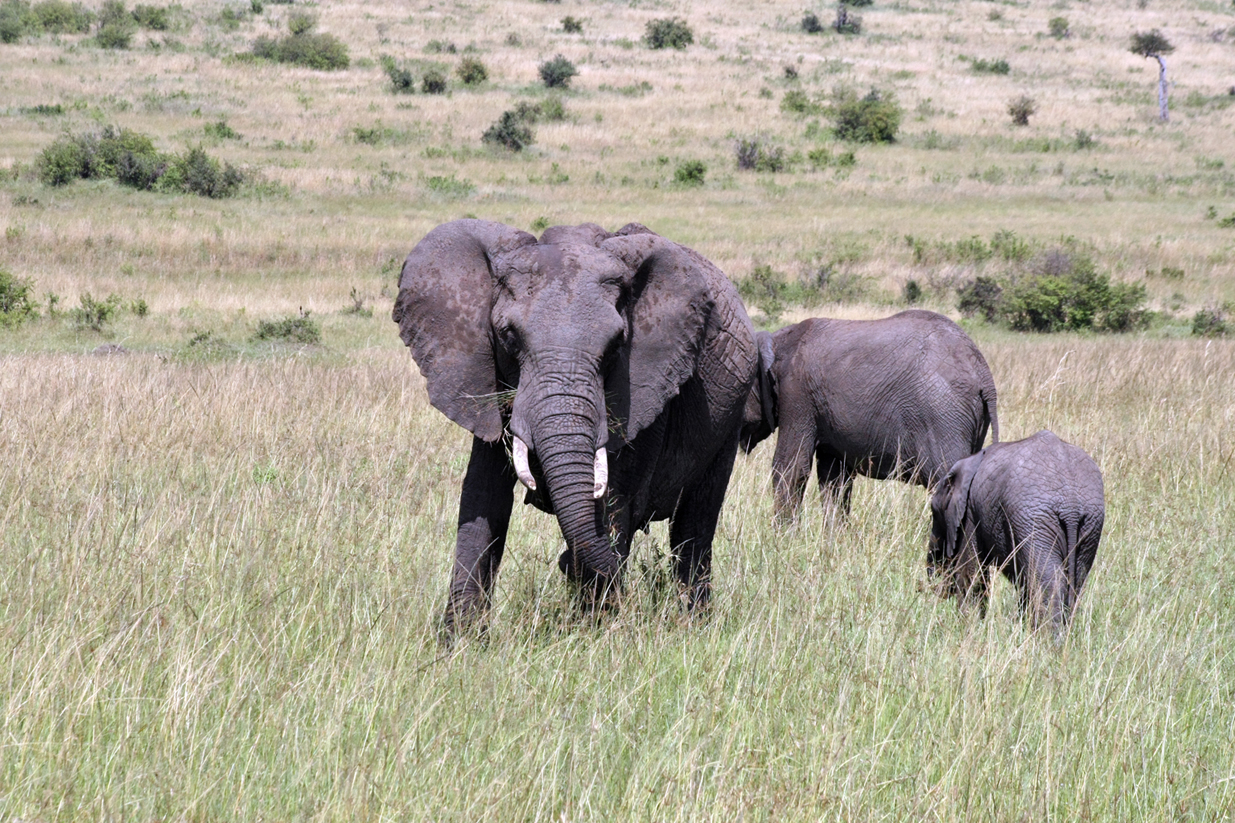
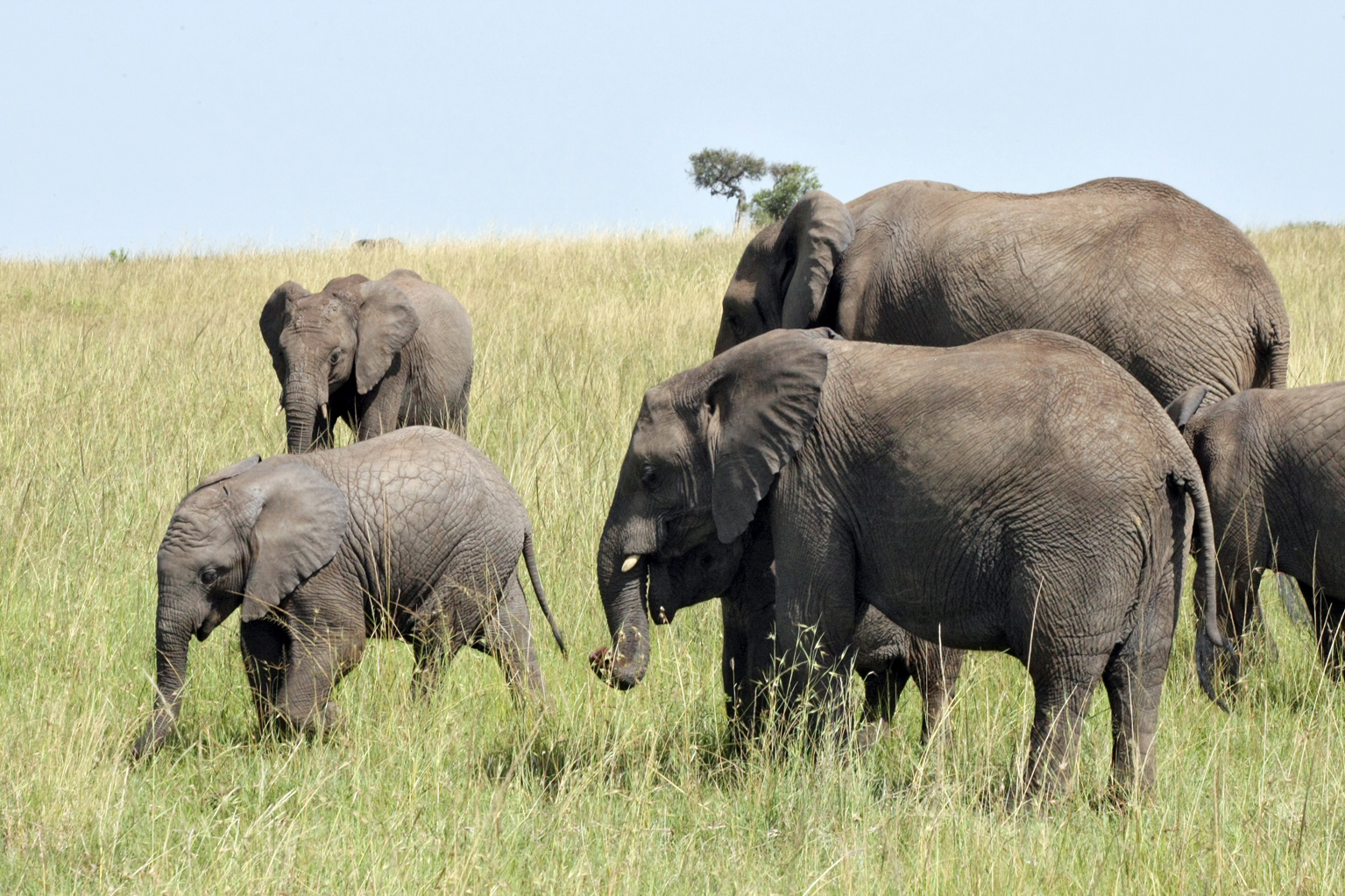
After breakfast we joined up with more of the group who had taken a balloon ride that morning. So now we were three vehicles. We headed off in search of a leopard, driving through a huge herd of buffalo and a large family of elephants consisting of adults, youngsters, and babies. We stopped the vehicle as the elephants wandered past tearing up chunks of grass as they went. They came so close that standing up in the jeep you almost felt like you were one of the herd. They moved on all too quickly.
I notice the Egyptian geese are back in their pond as they gently glide between the flowers floating on the surface of the shimmering water. A little further on and the vehicle abruptly stops, Alison has seen an owl in a tree, it is a Verreaux’s Eagle Owl, the largest and most powerful of the owls that live in the Maasai Mara. It is unusual to see these birds during the day as they are generally nocturnal, I was so concentrating on the owl near the end of the branch that I didn’t even see the second owl further into the tree until I looked at my photos later that evening. Maybe these two are also a couple.
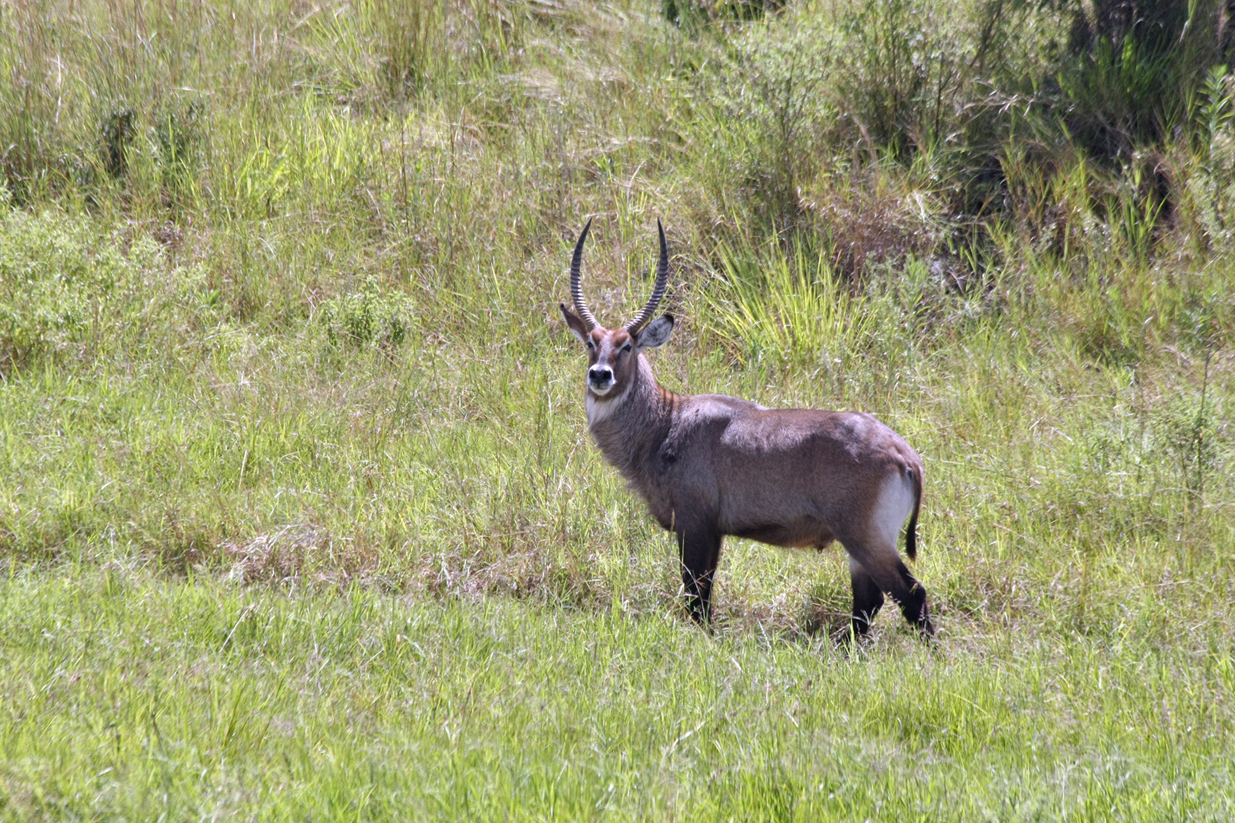
We approached the river where a leopard had been spotted earlier, drove in and out of the bush to get as close as we could, but unfortunately no leopard. We did see a nice group of female waterbucks who had wandered into the territory of this fine Male. I think waterbucks, together with the Impala are the most beautiful of the antelopes here.
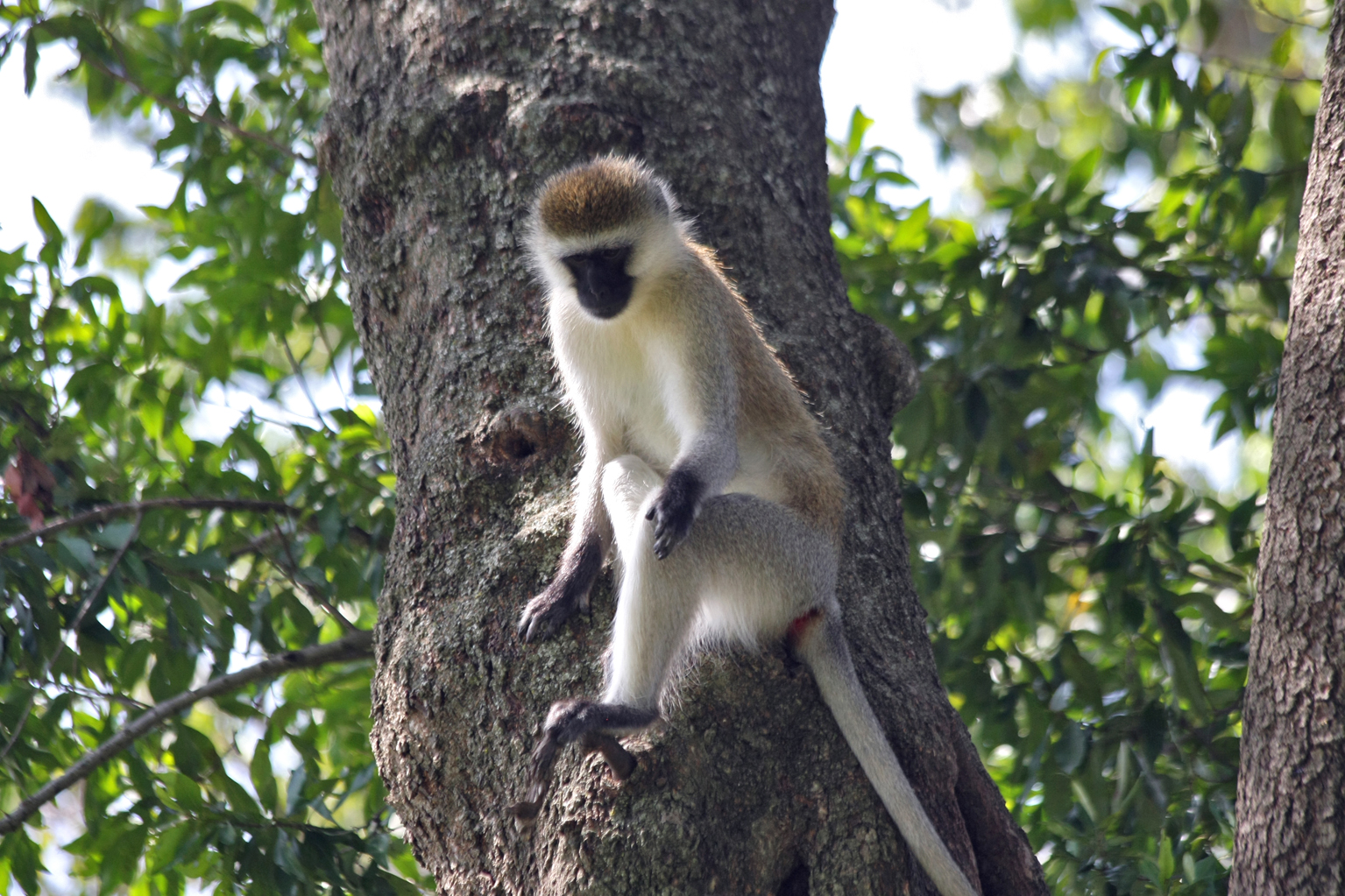
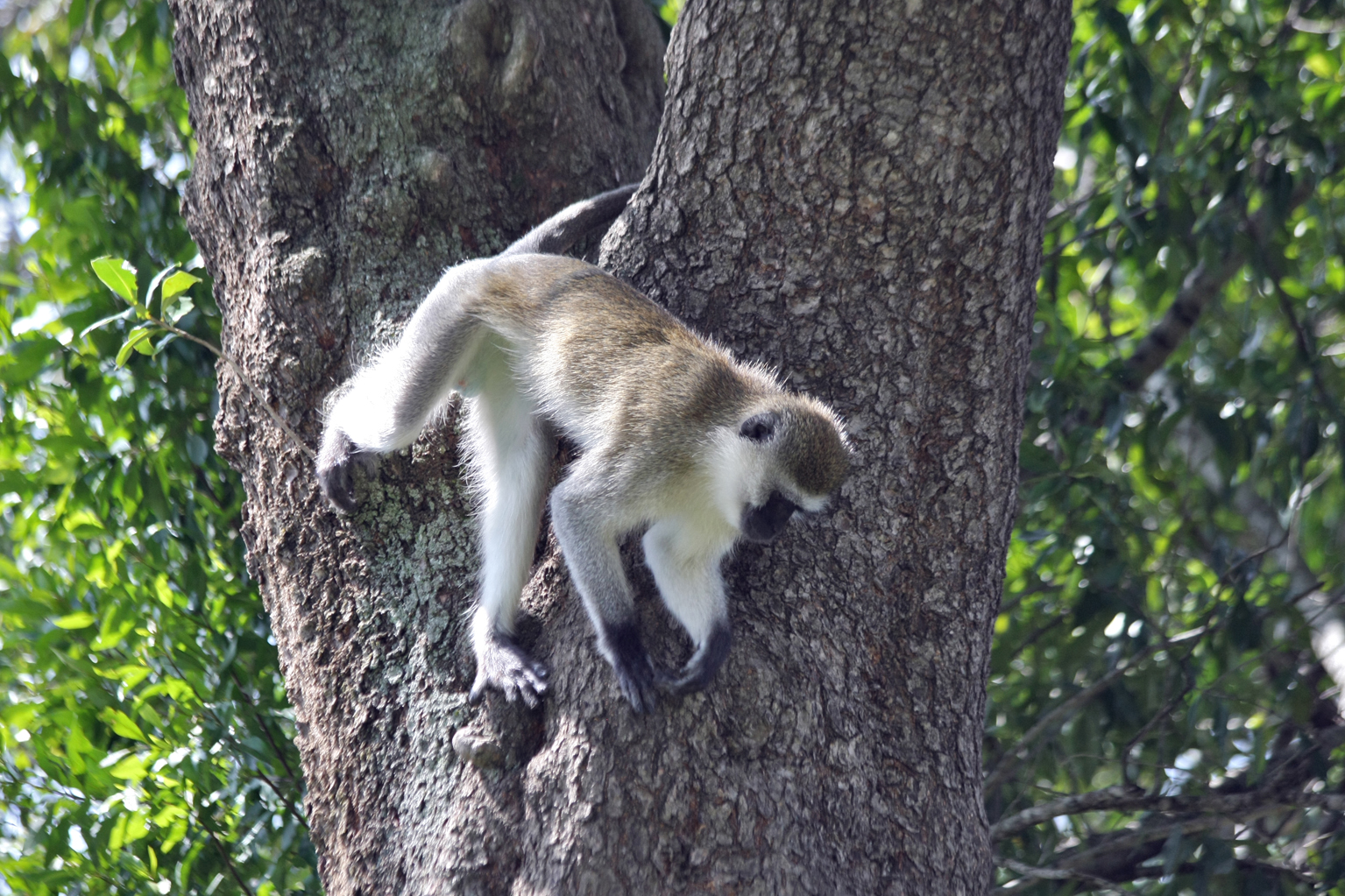
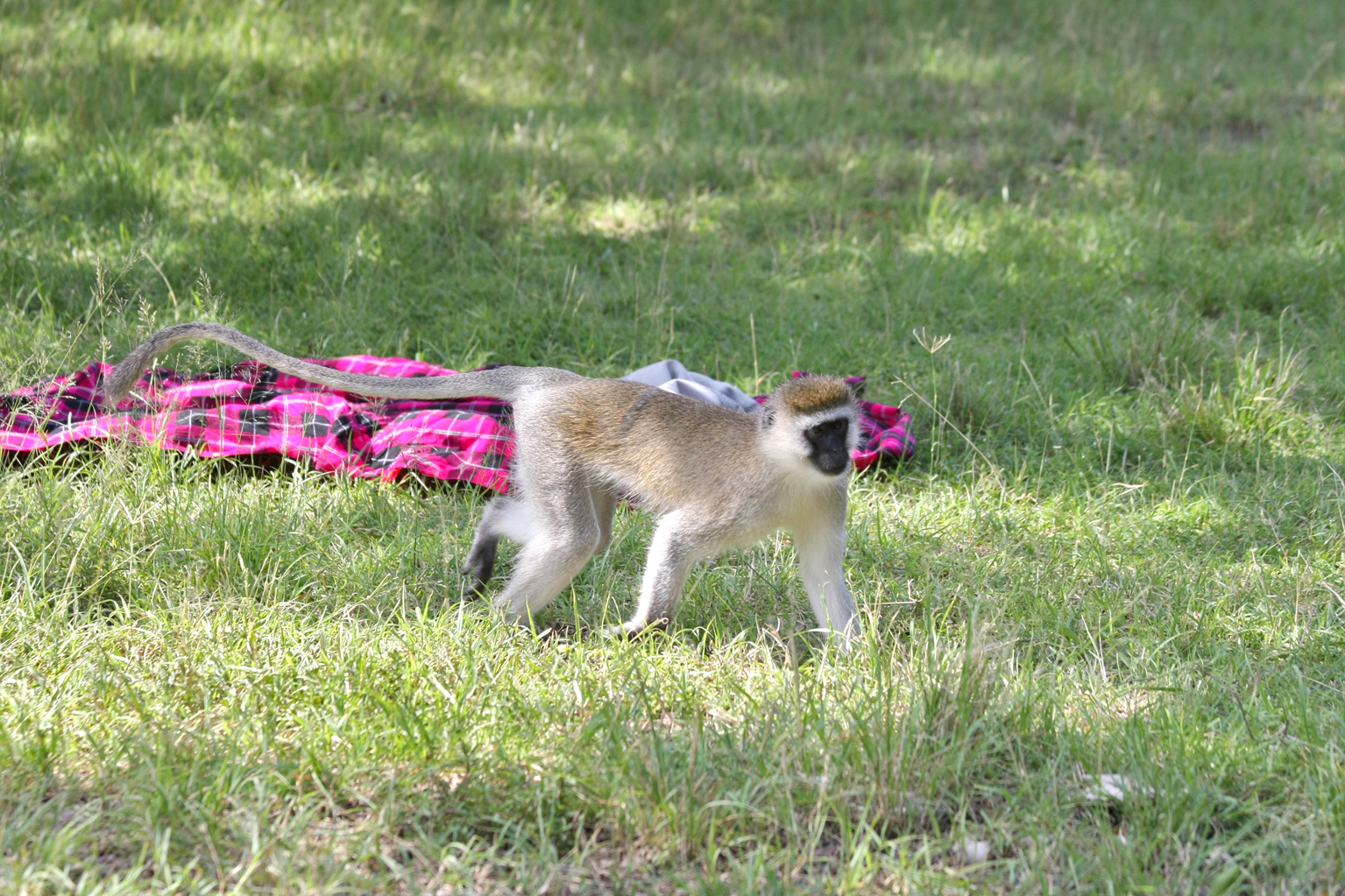
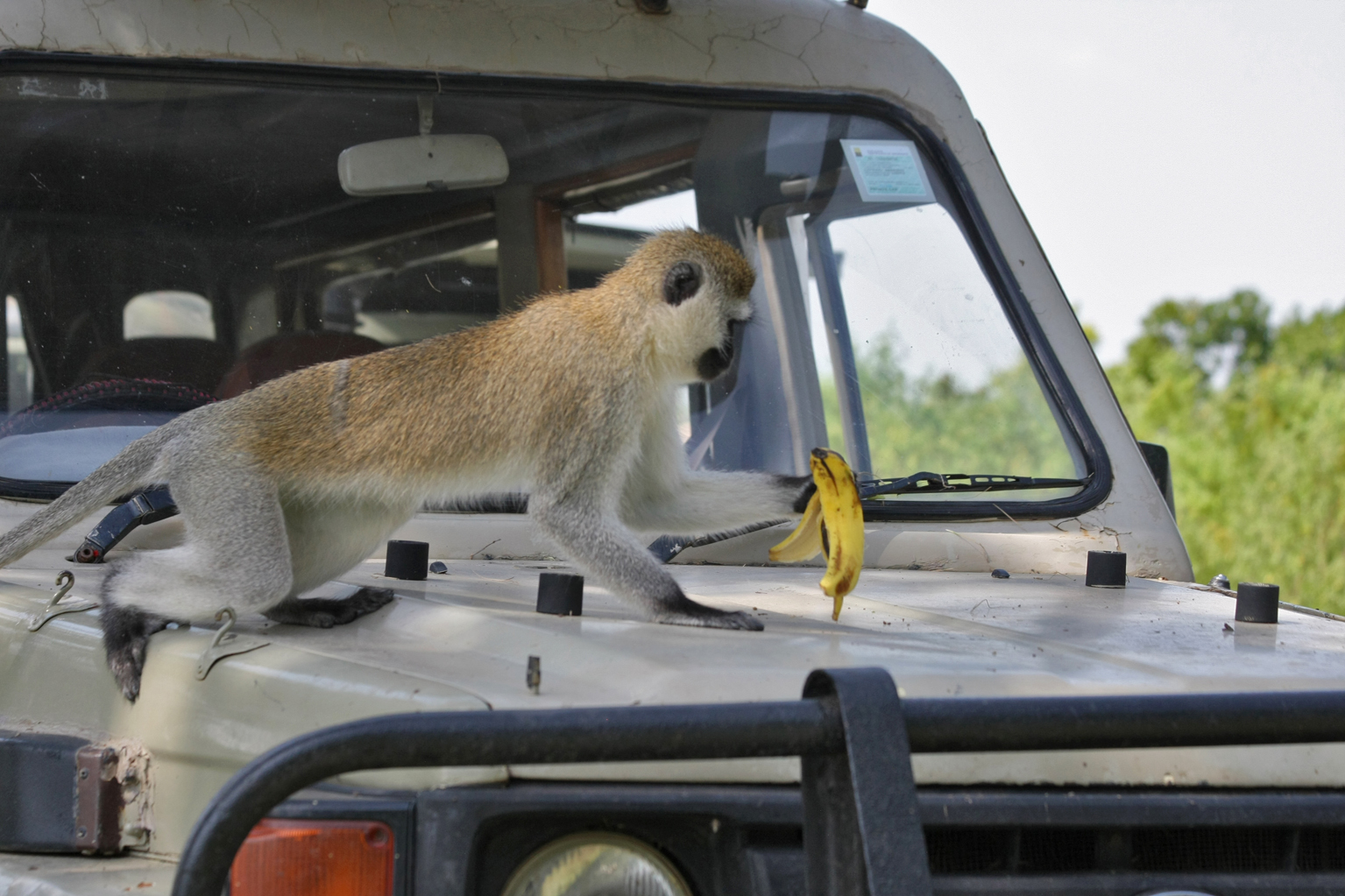
Since we had no luck finding the Leopard we stopped for lunch. It was a lovely, secluded spot surrounded by trees. It wasn’t long though, before we were joined by an uninvited guest, a vervet monkey attracted by the smell of the food. He sneaked in, at first staying in the trees awaiting his chance, which came when someone after eating a banana put his banana skin on the hood of the car, within seconds the monkey was down, grabbed it, and back into the tree. He was very cheeky, and it was very amusing.
We tried again after lunch to find the Leopard, but it just wasn’t to be today. The group were not too disappointed as they had already had a glimpse of a Leopard on their game drive yesterday, very close to the camp, a very shy leopard, hiding in the thick bush. The afternoon was very quiet as far as the cats were concerned but we did see many of the other animals, buffalo, giraffe, antelopes, zebra. We returned to camp tired but happy.
The first thing we see after crossing our small stream into the park is a group of noisy guinea fowl, followed by one of the local Hyena. As we enter an area known as the salt lick, just before we emerge out onto the plains, we find a large herd of Zebra here. It is known as the salt lick due to the high mineral content in the ground, the Maasai regularly bring their cows to it and the wild animals use it for the same reason.
We see the usual animals as we drive over the plains, for those that are here on a game drive for the first time it is amazing, for us we see it every day and with a pair of binoculars we don’t even have to leave the camp. So, we drive straight through the herds of antelope, wildebeest and zebra.
The plan this morning is to find the blackrock females and their cubs as I hadn’t seen them for a few weeks now. Alison had seen them a couple of days ago near the sand river while out on a game drive with guests, so we started from there. We drove to the top of a hill overlooking the sand river, Alison took the binoculars, carefully scanned the whole area and found no sign of them. In fact there was no animals around, nothing at all, which was most unusual. So we widened the search heading upstream. We pass the pond where we had seen the Egyptian geese and herons on previous drives, it was empty, no birds, nothing. We did see fresh hyena footprints on the track but no Hyena. As far as the eye could see nothing but a solitary topi in the distance, standing on an anthill, creating the impression that he was standing on top of the long grass, then it starts to rain. These quiet periods give me time for reflection, and it is during these times that I come up with some of my best ideas.
Eventually we admit defeat and stop for breakfast. It is a lovely spot with a view over the sand river.
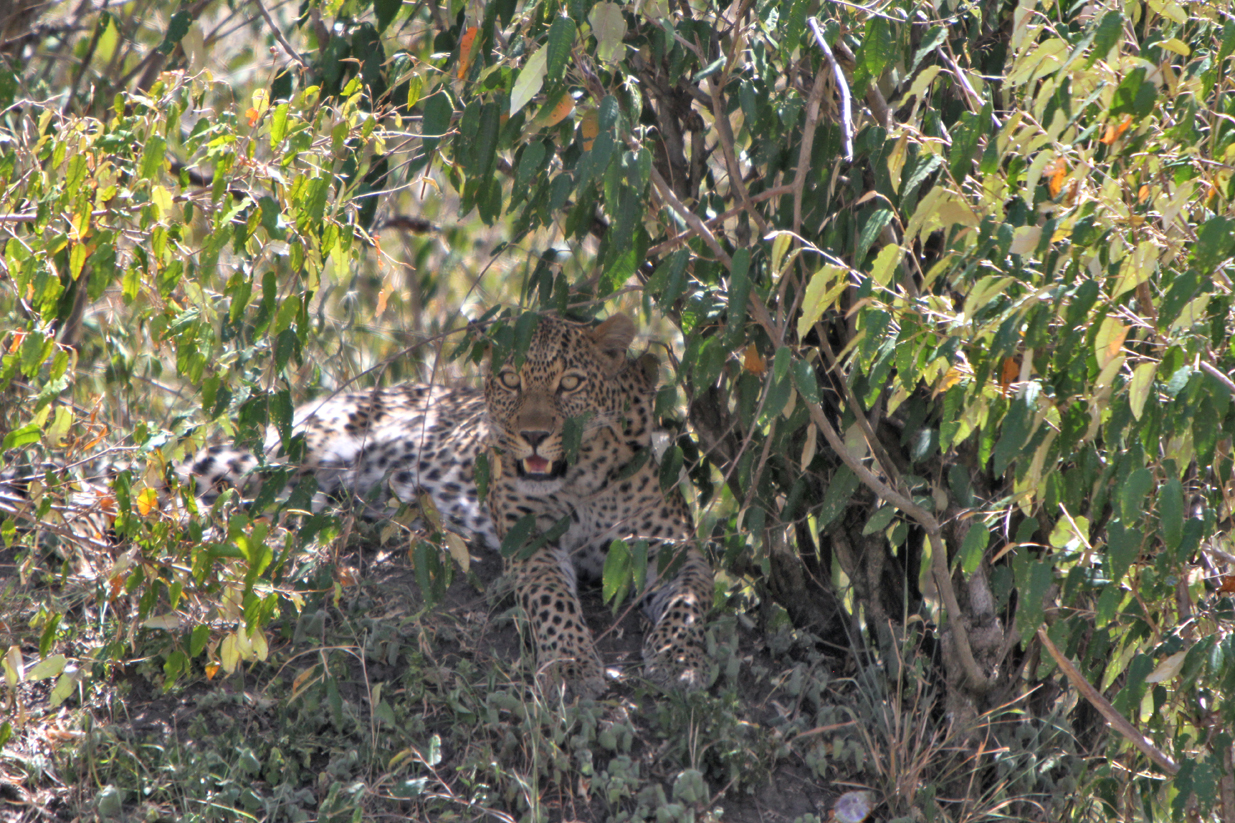
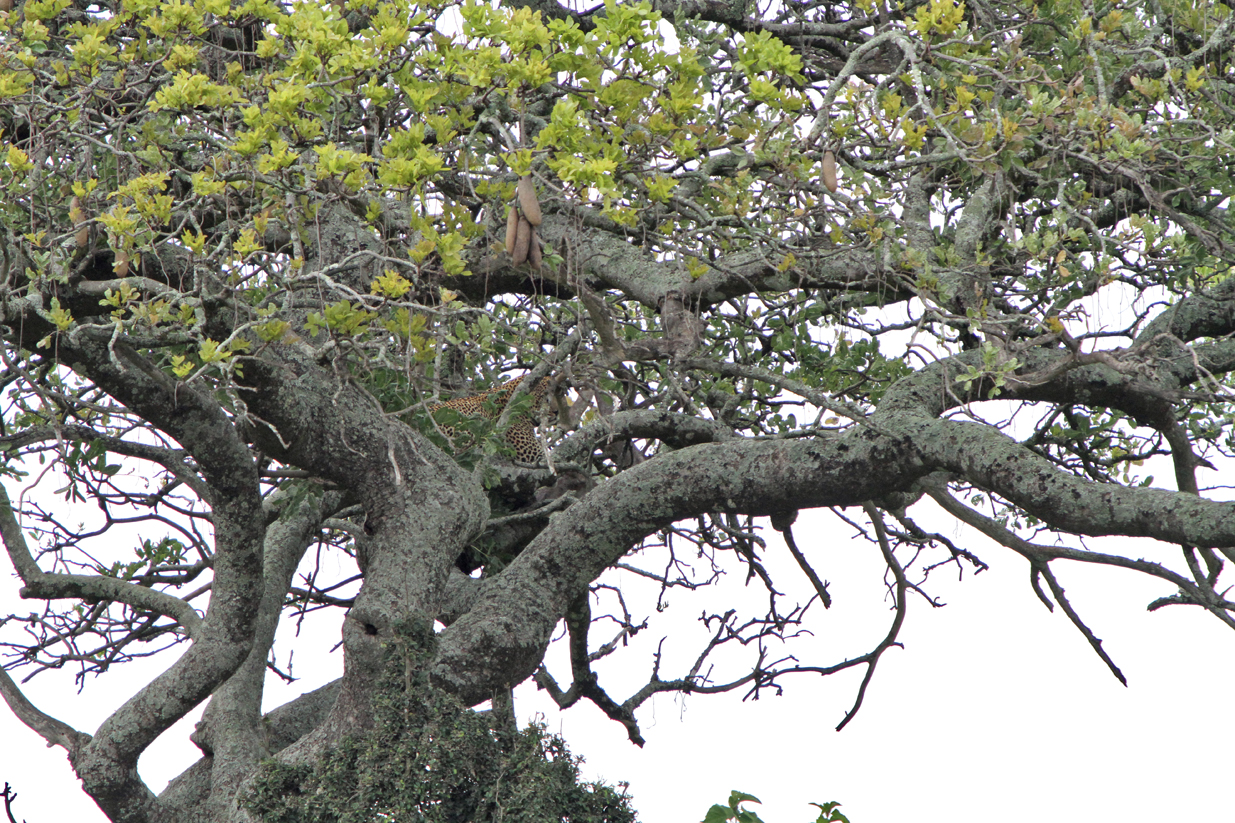
After breakfast we continue driving along the banks of the river when Alison points to a tree on the opposite bank that apparently had a leopard in it but of course neither me nor Ken could see it. I inspect the tree carefully and after a while and a lot of pointing, I see a tail hanging down from one of the branches, I had never been so excited to see a tail, finally we had found an animal, if you look at the photo you will understand why leopards are usually so difficult to see. He decided to come down the tree and we briefly got a better look at him before he disappeared into the long grass.
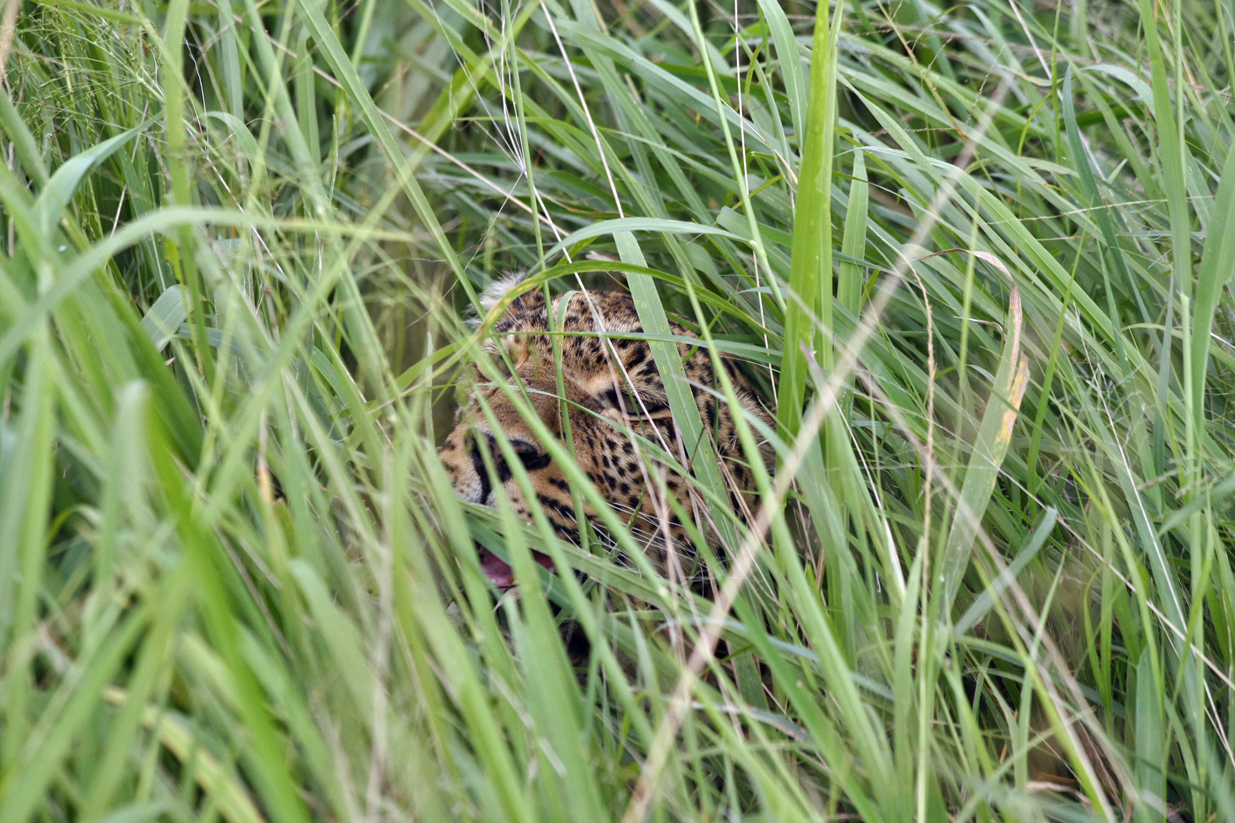
In the meantime, Alison had got a call about another leopard not too far away, so we headed off. We drove as fast as the terrain would allow; it wasn’t far but still took around 20 minutes. When we arrived at the tree with the carcass of an antelope hanging from a lower branch there was just one other vehicle there, however they weren’t looking up into the tree but into the dense grass at the foot of the tree, we were informed that’s where the leopard was. This time even Alison couldn’t see it, it was so well hidden.
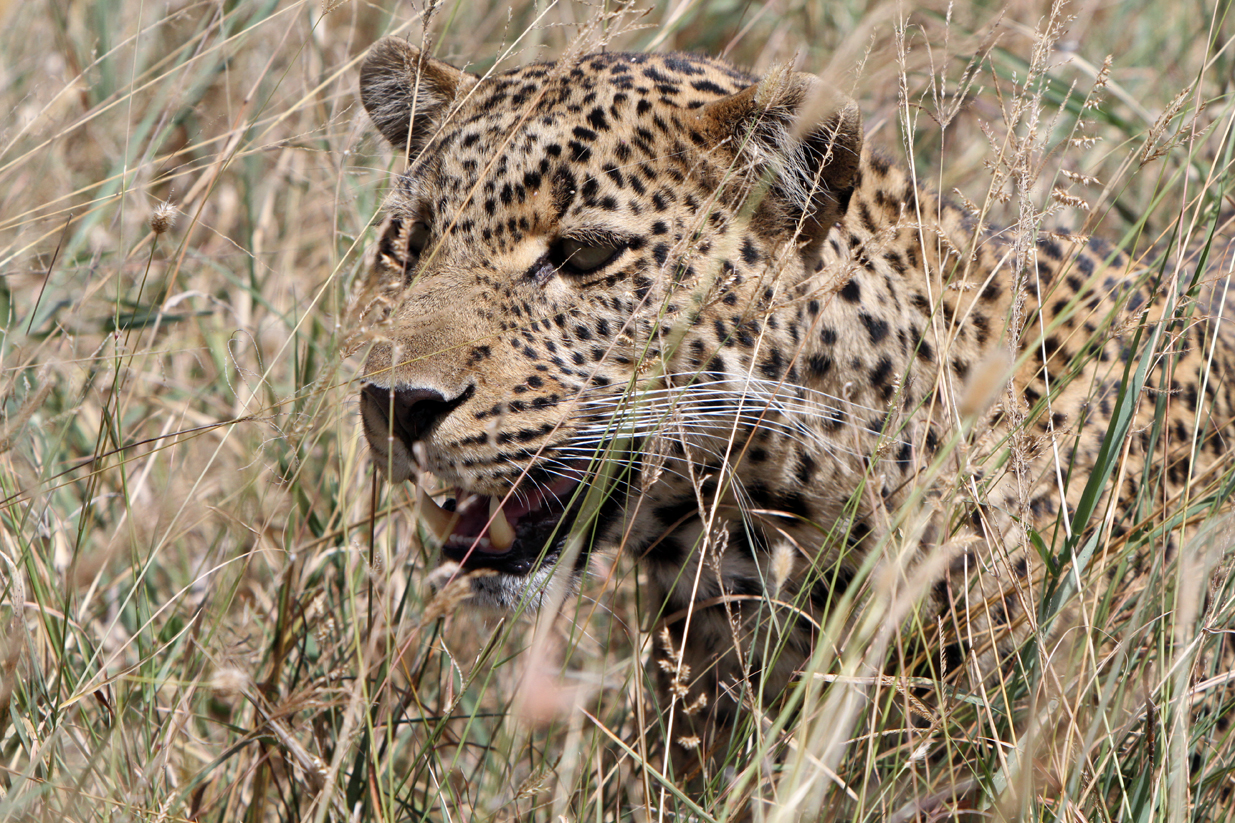
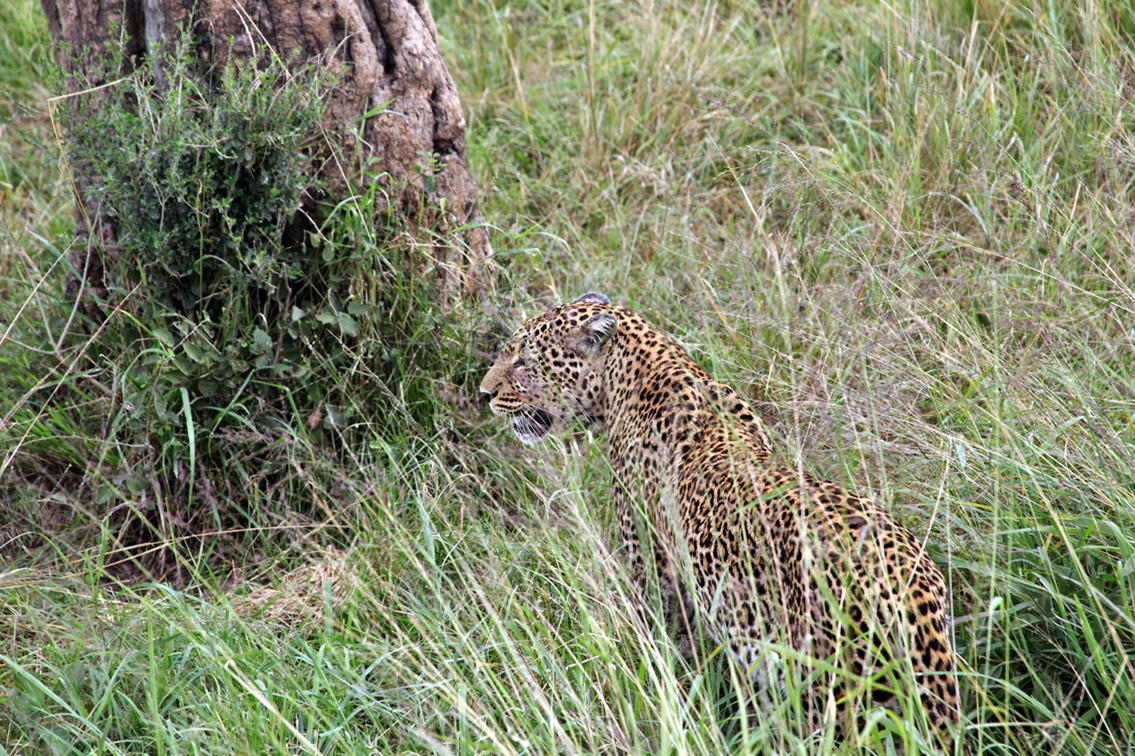
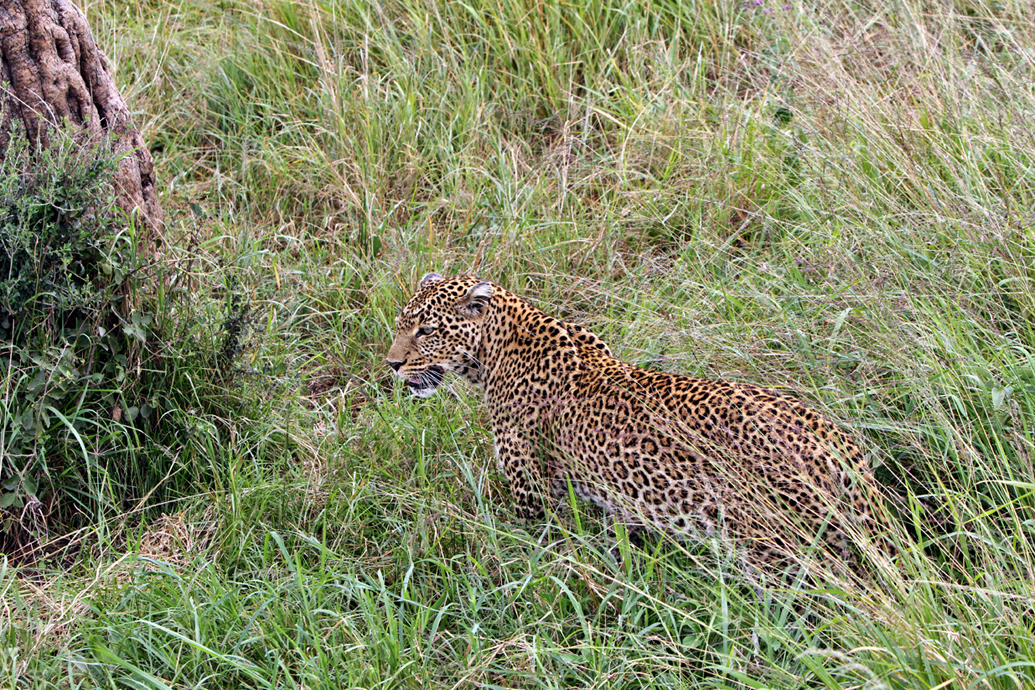
So, we sat there looking at the grass for what seemed like ages before another vehicle pulled up, the leopard was clearly disturbed by this because she came out of hiding for a few seconds to snarl and hiss at the intruder. I scrambled to get my camera ready before she disappeared again. I got a couple of clear shots, enough for Alison to recognize her, it was Zuri, the mother of Kazuri, she is quite old which explains why she wasn’t keen on all the attention.
He recognized her partly because she has some teeth missing but Judging by the carcass in the tree she is still able to hunt and look after herself.
So, we left her hiding and headed for the sand river gate crossing into no man’s land. We chose an elevated area giving amazing views of Kenya on one side and Tanzania and the other. We saw a few groups of wildebeest and zebra leading the migration heading towards the Maasai Mara through the sand river. They are early this year, in a week or so there will be thousands crossing both this river and the Mara River in search of fresh grass, which we have in abundance due to the recent rains.
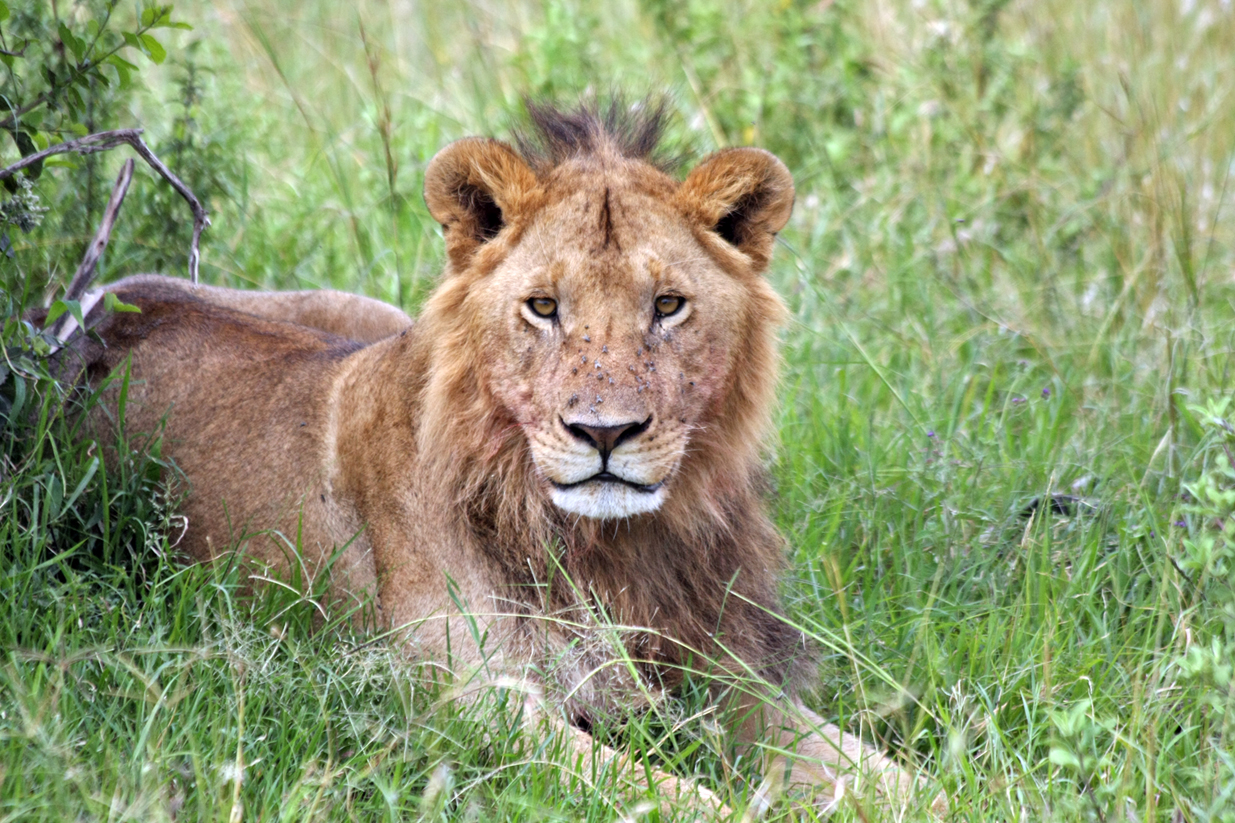
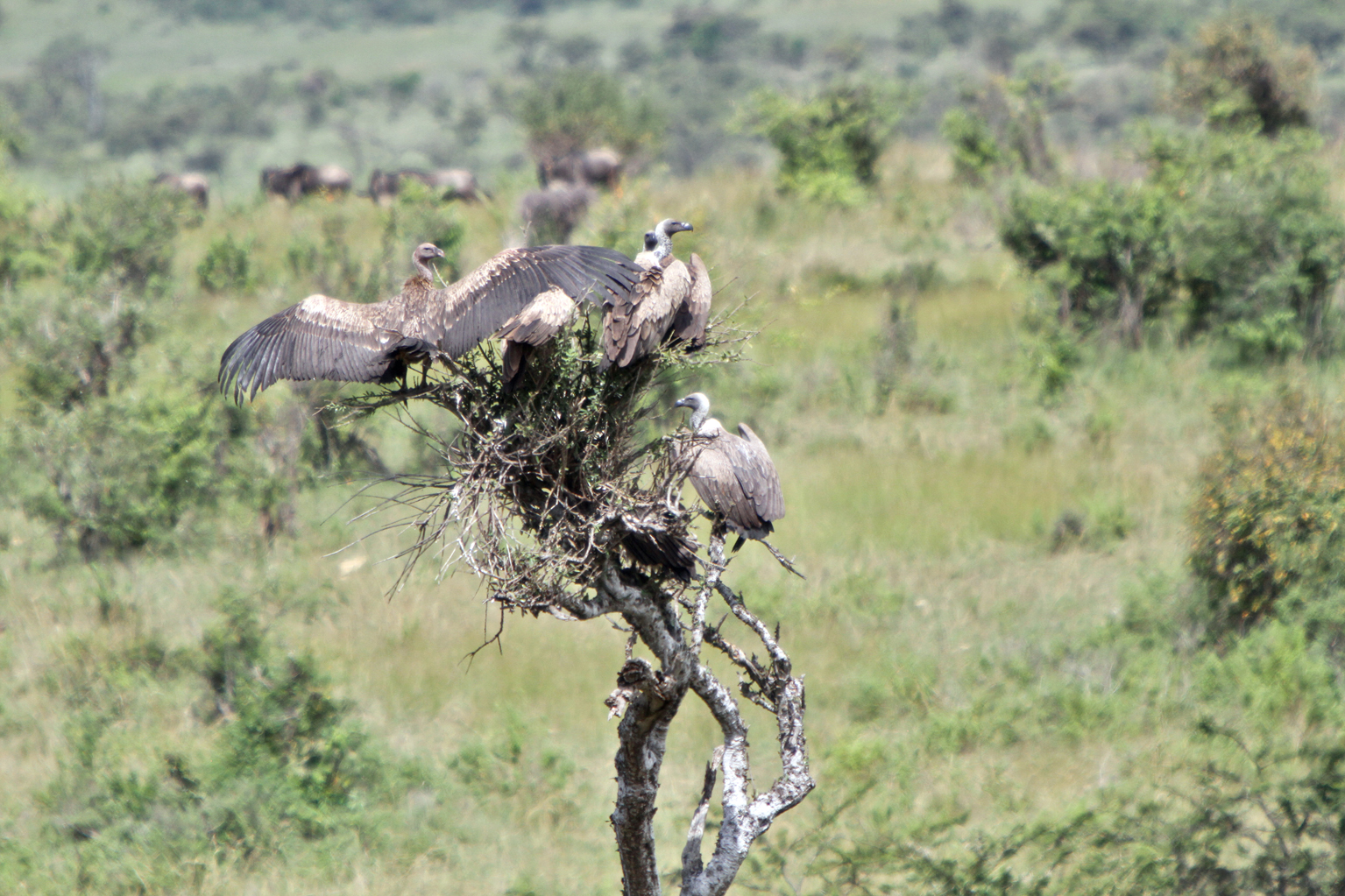
This of course attracts the predators, who are really happy to see them. We notice a young male lion sitting in the shade of a bush with the almost intact carcass of a zebra who didn’t make it into the Mara this year. A short distance away is a Jackal, just his head and ears visible above the long grass, and vultures gathering in nearby trees, all waiting for scraps, none brave enough to move in while the lion is there.
The young lion is in his element here as he sits looking across the landscape confident in the knowledge that this all belongs to him. As we sit watching the lion a group of wildebeest pass fairly close, the lion notices them and starts to stalk them, it must be just instinct as he has more than enough to eat, it’s not a serious attempt to hunt though, he makes a show of running at them, just enough to spook them, but then returns to his meal.
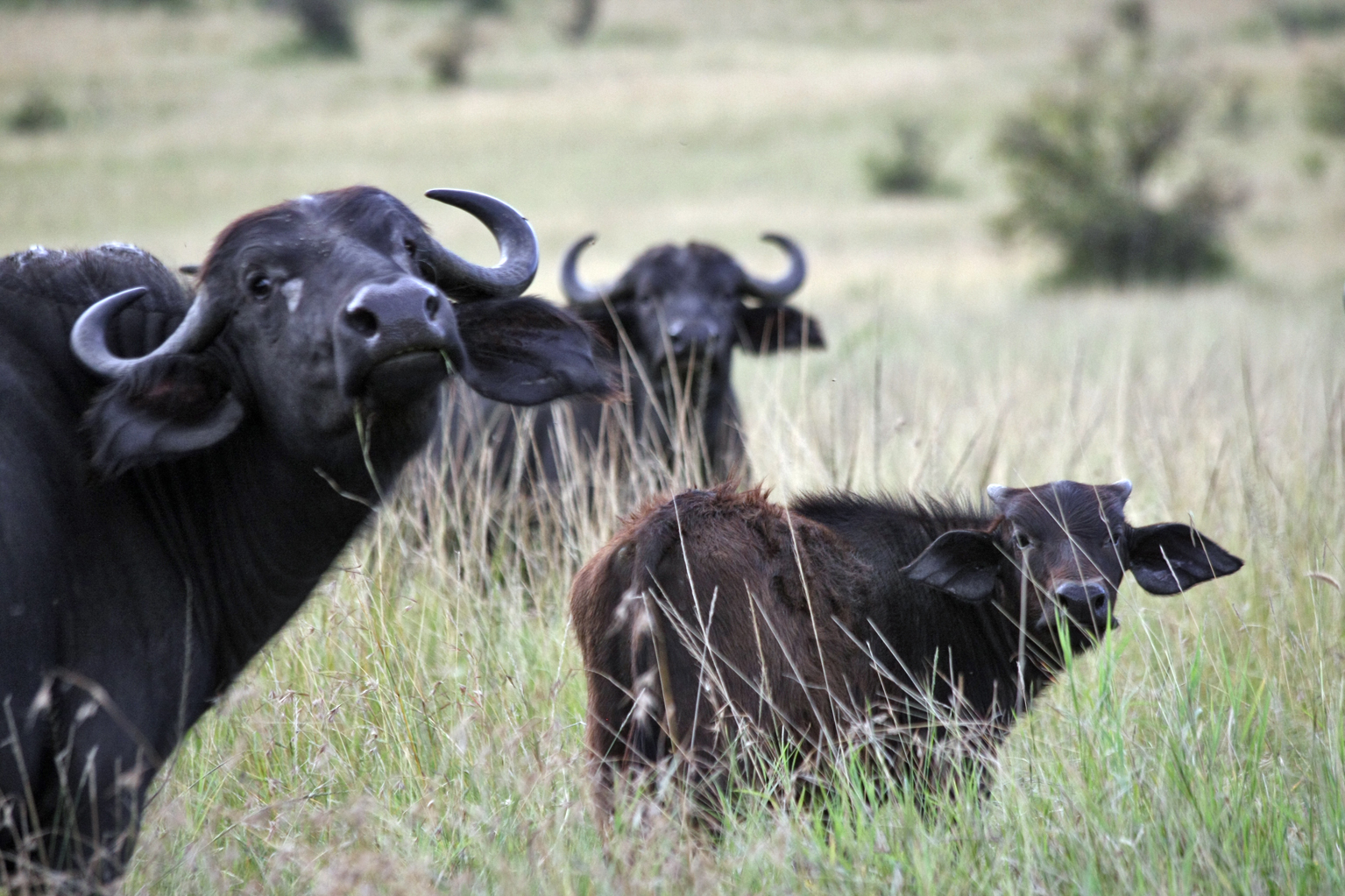
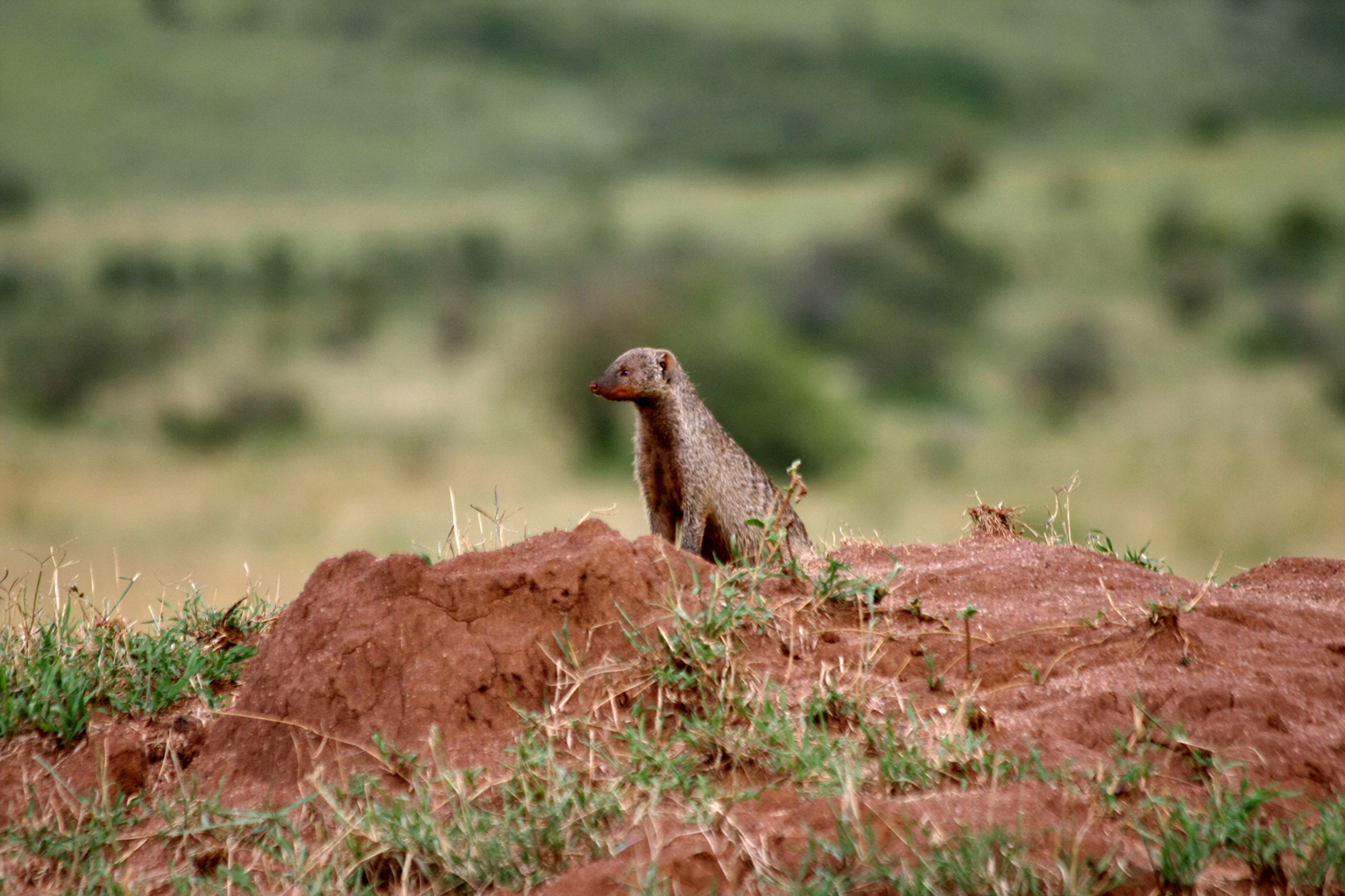
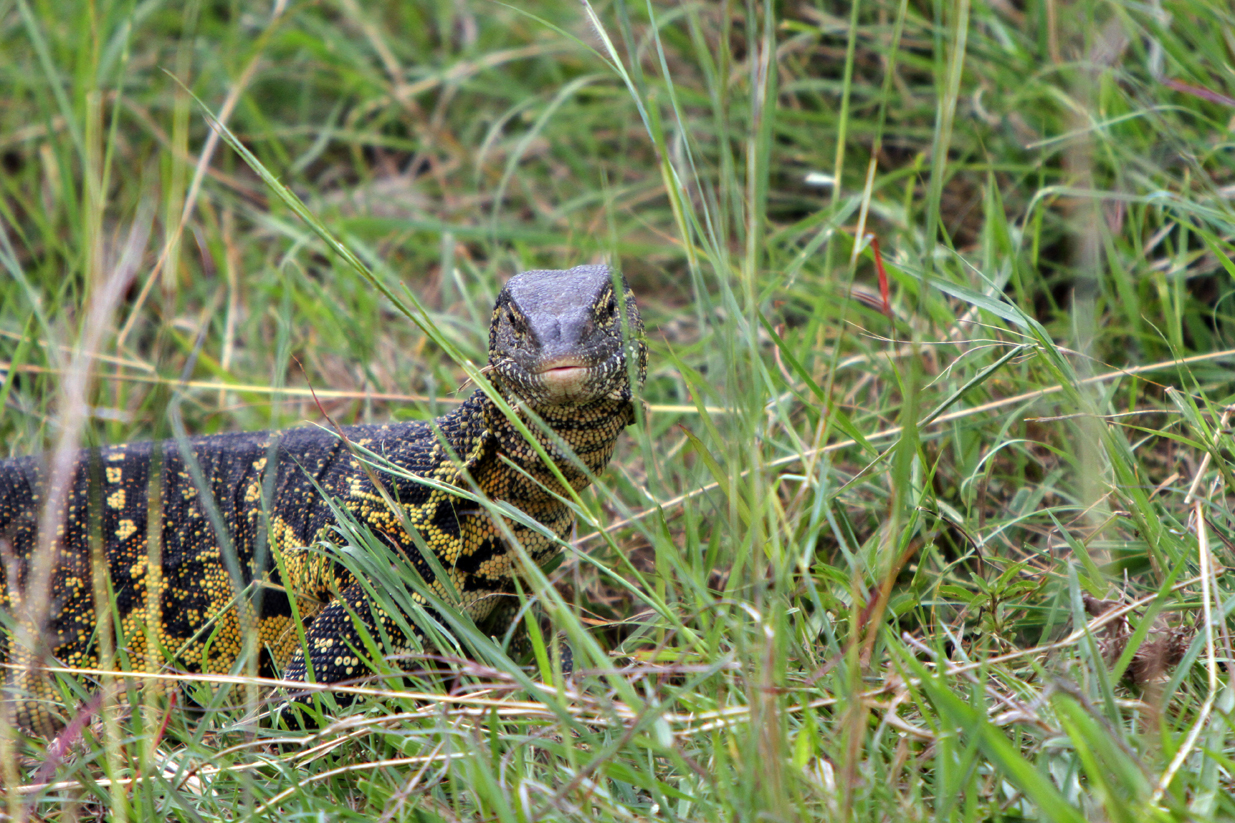
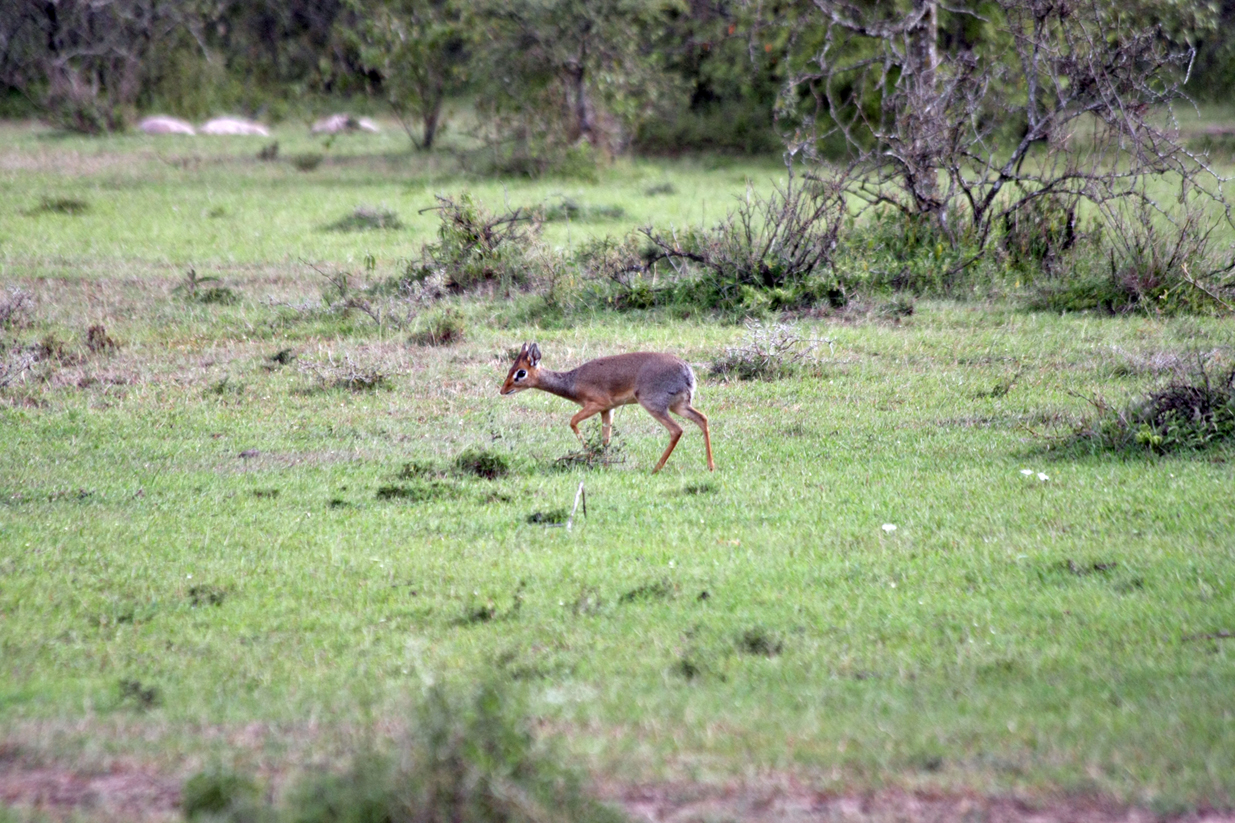
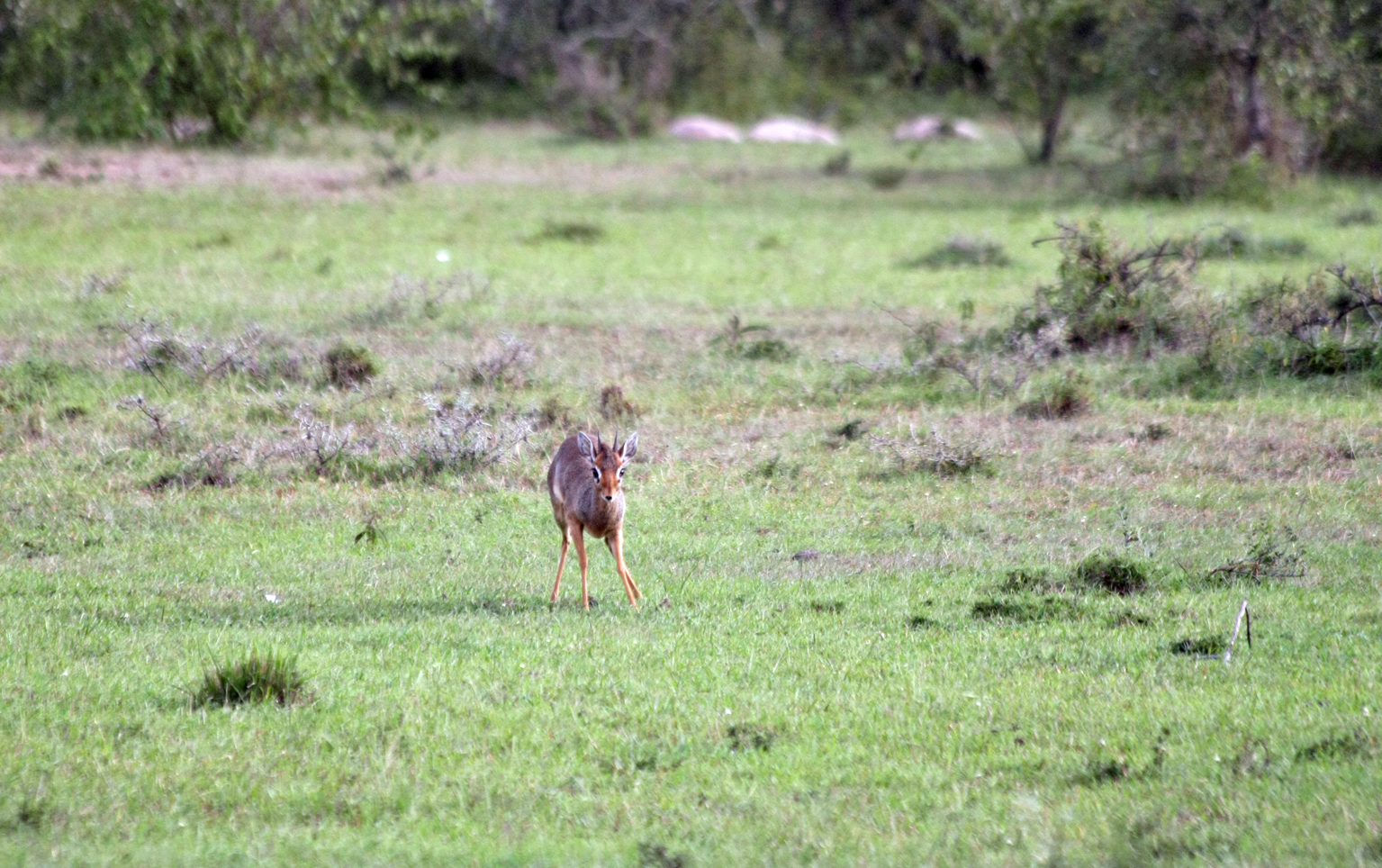
It is time for us to start heading back to camp. As we drive through the empty landscape again, I was thinking that I hadn’t seen a buffalo all day and just then as we are a mere fifteen minutes from camp we come across a huge herd of buffalo, as we drive closer to camp we pass more and more animals, mongoose, two yellow billed stork, a monitor lizard, then onto the plains so many different animals co-exist, Giraffe, Zebra, gazelles, Impala, Topi, Warthog, Jackal, to name but a few. All grazing peacefully together in the same territory. Wouldn’t it be nice if humans could do the same?
Even the sun made a brief appearance. It had been a very quiet day in all, but very pleasant.